
Lucas Frost
19 May 2026
What is an eSIM adapter? How does it work?
Travelers switch to eSIM for a stable and flexible connection. Many of them get excited and buy an eSIM plan and try to activate it on their phones without even realizing that their device doesn't support eSIM. That is an obvious mistake new eSIM users make. Before buying any eSIM plan, it's always smart to check if your device supports eSIM.
It's more common than you'd think. eSIM is a digital chip card, and it is built into the latest modern devices. And still many of us use older phones or budget Android devices, which are not eSIM compatible. If you are one of those who already know the eSIM, wait a moment, I have a solution for you.
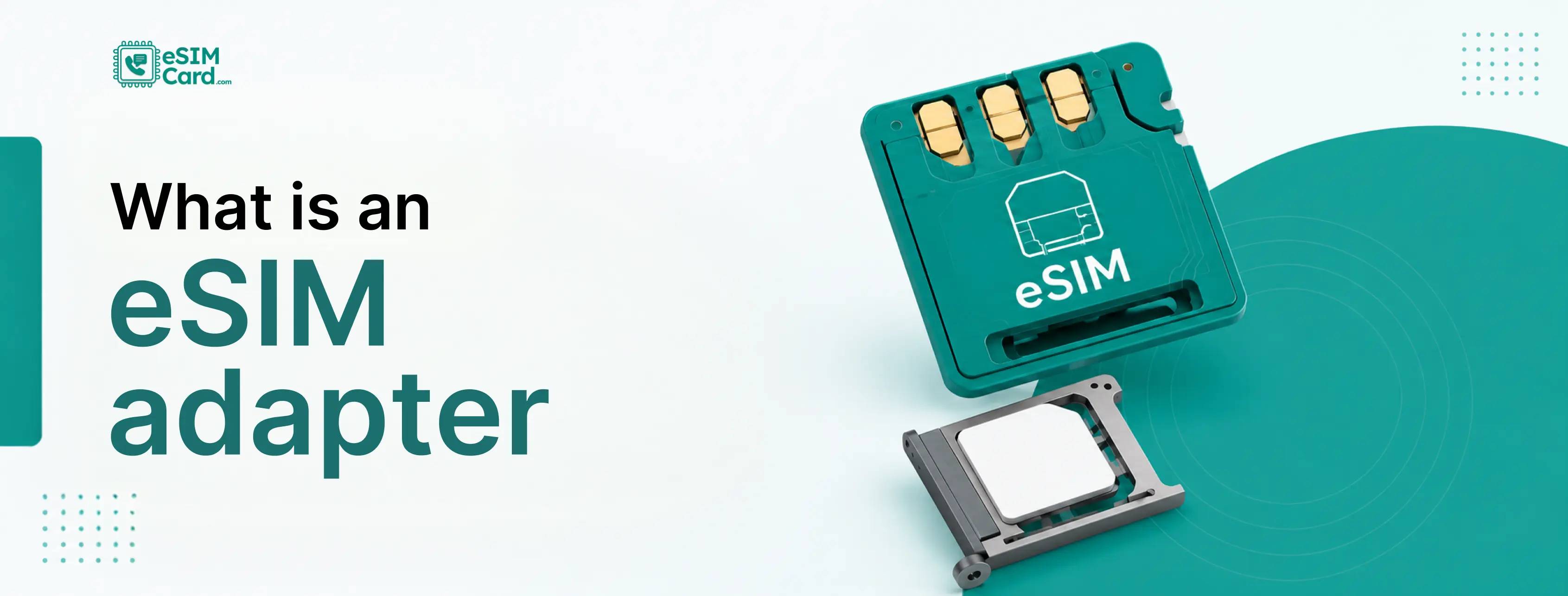
An eSIM adapter is the chip that allows the non-eSIM supported devices to use an active eSIM. It works like an eSIM card and helps you stay connected effectivity without physical swapping.
In this guide, I will discuss what an eSIM adapter is and how it works, how you can get it, and use it on your Android and iPhone devices. Similarly, I will discuss its pros and cons for your clear understanding.
4.9

Highly Rated
Based on 500,000+ customer reviews

Trusted worldwide
Over 1 million travelers across the globe have trusted us

Travel Friendly
No swaps, global connectivity ensured
What Is an eSIM Adapter?
An eSIM adapter is like a physical card. It looks exactly like a traditional SIM card, the same nano-SIM size, and a little tray slot. Apparently, there is no major difference between the SIM card and the adapter.
A regular physical SIM card generally holds your network credentials on a fixed chip, such as a carrier's details and account. In comparison, an eSIM adapter holds a programmable chip called an eUICC. eUICC is a standard defined by GSMA, the international body that governs global mobile network standards.
Here, the chip is actually the major component. It stores information, including multiple eSIM profiles, switches between them, and manages digital network credentials. So when you slide one into your SIM card slot, your phone sees it as a normal SIM, but it's actually running as an eSIM profile.
Why Does an eSIM Adapter Exist?
An eSIM adapter is the best solution for devices that don’t support eSIM technology. The adapter helps your device to access a consistent connection like a real eSIM.
eSIM plans got popular fast, especially for travel. Travelers often avoid heavy roaming charges by switching to eSIM data plans. But phone hardware didn't upgrade at the same speed.
Millions of people still use phones from four or five years ago. Devices bought in certain markets where eSIM was never enabled in the first place. Older models that just never got the feature. For all those people, eSIM plans can be significantly cheaper than roaming or airport SIM cards.
And once you buy an eSIM plan, there's usually no refund. So if you paid for one and then discovered your phone doesn't support eSIM, you're stuck. The adapter is the fix for that. It also works for things beyond just phones.
How Does an eSIM Adapter Actually Work?
Its working is not complex. You buy the adapter, and it has a companion app; every brand has its own. You install the app, insert the adapter into your phone, and then load your eSIM profile onto it.
The most common procedure for eSIM activation is QR code scanning. Most eSIM providers give you a QR code when you buy a plan. You open the companion app, scan that code, and the app writes the SIM profile data to the adapter's chip. That's it.
The adapter stores the eSIM profile, and from that point, your phone treats it like another physical SIM card. What's actually useful is that the adapter can hold multiple profiles. If you are visiting more than one country, you can load different eSIM profiles and switch between them in the app.
Who Need eSIM Adapter?
An eSIM adapter is not for everyone. If your phone already supports eSIM, you don't need an adapter at all. You can add an eSIM plan directly to your phone settings quickly and easily.
You may need an eSIM adapter if your situation is any of these:
- Your phone only has a SIM card slot and no built-in eSIM support.
- Your phone was bought in a market that disabled eSIM. That is mainly common in Chinese market variants, even some iPhones sold in mainland China don't have the embedded SIM functionality.
- If you want to use eSIM plans on a tablet or router.
In these situations, yes, you need an adapter, especially for travel. Because eSIM plans for international data are often cheaper than roaming charges. And for the non-eSIM compatible devices, it is a perfect match.
Does It Work on Android?
Yes, most eSIM adapters are specifically designed for Android phones. You can follow our step-by-step guide on how to set up eSIM on Android for a smooth experience. The key requirement is that your Android phone runs Android 9 or later and supports Open Mobile API (OMAPI). The companion app uses this interface to communicate with the adapter's chip.
Not every Android has OMAPI. So before you buy an adapter, you should check compatibility. Generally, the adapter brands have a checker tool built into their app.
If your Android phone does support it, the setup is pretty simple.
- Insert the adapter into slot 1 if you have a dual SIM.
- Download the app and enable data roaming in settings.
- Scan the QR code from your eSIM provider.
- The adapter downloads and stores the profile, and you're online.
Some popular brands in this space include eSIM.me, JMP, 5ber, and EIOTCLUB. All offers adapters that support eSIM on non-eSIM Android phones.
What About iPhones?
iPhones from iPhone XS (2018) onwards already support eSIM natively. So if you have a modern iPhone, you genuinely don't need an adapter.
For older iPhones without eSIM support, you can use the adapter. But compared to the Android devices, the eSIM adapter for iPhone compatibility is limited. Most adapter companion apps aren't available on the App Store, which makes setup tricky.
The Setup: What Can Go Wrong
The most common problem people run into is that they insert the adapter and nothing happens. Usually it's one of three things:
- They put it in slot 2 instead of slot 1.
- Forgot to enable data roaming.
- Their phone simply doesn't support OMAPI, and the app can't talk to the adapter at all.
Sometime QR code scan fails or shows an error. Check if the code's already been used. One more thing to focus on is to ensure you check your internet connection during the activation.
If you're getting a connection but no data is available, you need to enable APN settings manually. Some profiles don't configure this automatically on all Android phones.
eSIM Adapter vs. Native eSIM: What's the Difference?
Embedded SIM and a native eSIM card are not the same.
An eSIM card is built into your phone's motherboard during manufacturing. It's fast, stable, and supported by the operating system directly. You can simply activate it through Settings, without any extra app or external hardware.
An eSIM adapter is a workaround. It does a similar job to eSIM, but it goes through an external chip. It uses a companion app and requires your phone to support OMAPI. You can call it a bridge that helps your device to access a stable connection, like having a native eSIM.
If your phone supports eSIM, activate the native eSIM. Here is how you can check your device's eSIM support from settings.
- Go to Settings.
- Scroll to About Phone and look for an EID number.
- If no EID is listed means no native eSIM support, and the adapter route is your option.
Pros and Cons of eSIM Adapter
What works well?
- It allows the older non-eSIM compatible devices to use eSIM plans.
- The adapter stores multiple eSIM profiles, and you can easily switch between carriers.
- Works for travel in a way that saves real money compared to roaming.
- Also usable in tablets, routers, and other devices with a SIM slot.
Where it gets frustrating:
- To use the adapter, your phone must support OMAPI, and not every Android phone has it.
- Takes up your SIM card slot, so if you've only got one, your local number is gone.
- iOS support is mostly limited compared to Android phones.
- Voice calls and SMS depend on whether your eSIM plan includes them.
- If the adapter itself breaks or gets lost, you lose access to everything.
What About the eSIM Plan Itself?
The adapter is just the hardware. You still need an actual eSIM plan to load onto it. Here, the provider like eSIMCard comes in. Whether your phone has a built-in eSIM or you're running plans through an adapter, the eSIM profile from your provider works the same way.
The provider sends you the QR code, you can scan it with your phone camera, and the plan activates. For travel, especially, having a solid eSIM provider matters a lot. eSIMCard offers eSIM plans for 200+ countries. You can get your eSIM online in affordable price and enjoy a convenient connection 24/7.
So, Is It Worth Buying One?
It actually depends. If you travel a lot and your phone doesn't support eSIM, you should buy the adapter. It saves your cost on data plans that you spend on roaming or airport SIMs. And the flexibility of switching eSIM profiles without swapping physical SIM cards is real.
If your phone already supports eSIM, you don’t need it. Simply buy an eSIM plan from a reliable carrier and activate it in your device.
If you're thinking about upgrading your phone, just wait. Any decent smartphone bought in 2025 or 2026 almost certainly supports eSIM natively. Buy the new phone, skip the adapter entirely.
Conclusion
eSIM technology is moving fast. Apple already removed the physical SIM card slot from US iPhone models starting with the iPhone 14. More Android manufacturers are also following the same direction. The physical SIM card era isn't over yet, but it seems winding down.
For people with modern phones, eSIM is already there, adapter is not required. But for non- eSIM supported devices, the adapter is practical. It is an affordable option that lets you stay in the eSIM ecosystem without upgrading your phone right now.
FAQs
How can I check if my device is compatible with eSIM?
You can check your device's eSIM support from settings. Open Settings > Connections (or Network & Internet). Here, look for Add Mobile Plan or SIM Manager. If it's listed, it means your device supports eSIM.
Does Bell Mobility support eSIM?
Yes, Bell Mobility supports eSIM technology in postpaid and prepaid plans. You can activate an eSIM on any compatible device, and it provides a stable connection.
Are eSIM adapters reliable?
Yes, eSIM adapters are reliable for transforming a non-eSIM-compatible device into an eSIM active device. With the adapter, you can create the plan and switch between the profiles like a native eSIM.
Can I use an eSIM adapter with my smartphone?
Yes, you can use an eSIM adapter. These physical adapters generally fit into your standard SIM card slot and allow you to download and store multiple eSIM profiles.