
Lucas Frost
02 Jun 2026
eSIM vs iSIM: What's the Difference and Which One Actually Matters?
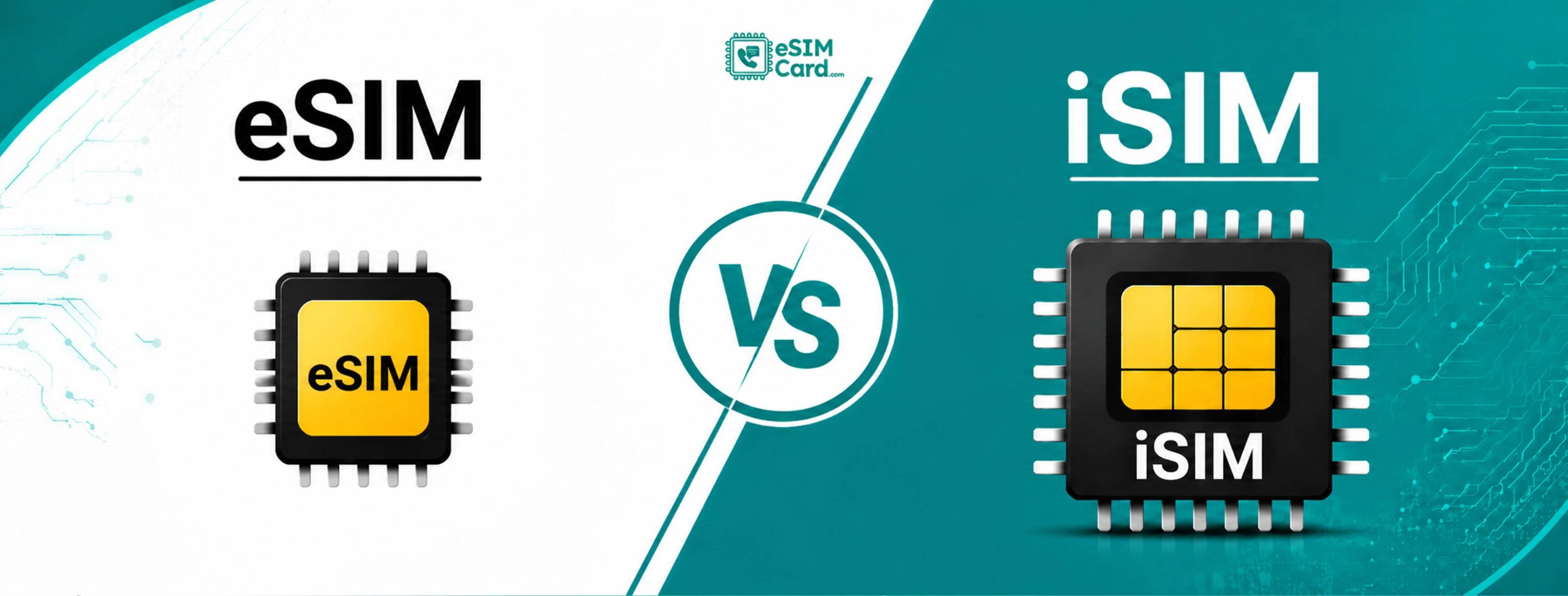
You may have heard of eSIM as the digital SIM card replacing the traditional physical SIM cards. eSIM is actually a tiny chip that sits on the circuit board of the phone. While an iSIM is the more modern version of eSIM, it lives inside the main processor without any hardware needed.
People are getting used to eSIM. It's only been mainstream for a couple of years, and a lot of phones still ship with a physical SIM tray alongside it. iSIM is now entering the conversation.
Both words eSIM and iSIM sound almost identical. Both replace the traditional plastic card and let you switch carriers without touching anything. So why do we need two different technologies?
That's what we're going to sort out here. In this guide, I will discuss eSIM vs iSIM, what each one actually is, how they differ under the hood, and which one matters for you right now.
4.9

Highly Rated
Based on 500,000+ customer reviews

Trusted worldwide
Over 1 million travelers across the globe have trusted us

Travel Friendly
No swaps, global connectivity ensured
What Is an eSIM?
Definitely, we are all familiar with the physical SIM cards and their functionality. So let's move to the modern version of it.
An eSIM is a chip that is permanently built into the device's circuit board. You can't remove it or swap it out. Compared to physical SIM swapping, you can change carriers digitally without a physical SIM swap.
The embedded SIM is built directly into a device's circuit board. It store the multiple eSIM profiles, and you can manage those remotely. So switching carriers or plans doesn't require. And you can say it's remote provisioning.
You can buy the eSIM online from carriers, like eSIMCard or Yaalo. For example, your are planning to travel to Japan next week, you can buy the plan, install it in your phone, and active it before you even land at your destination.
But one thing worth knowing is that eSIM doesn’t work in all devices. Only the latest smartphones support it. If you are looking for the best eSIM for international travel, it is genuinely the most practical SIM technology available right now.
Note: Most modern flagships support it, including iPhones since XS, most Samsung Galaxy S series from S20 onwards, and Google Pixel from the 3a.
What Is an iSIM?
iSIM is a protected area integrated directly into the main processor, the SoC, or system-on-a-chip. The iSIM doesn't exist as a standalone component. It's part of the processor itself, which does not require dedicated hardware.
You can understand it in this way. If a traditional SIM card is a separate room in a building, an eSIM is a cupboard built into the wall of that building. And the iSIM is a locked drawer inside the main office part of the structure itself.
The iSIM is built in a secure area on the SoC. It is safeguarded by a tamper-resistant element. It allows network carriers to preinstall or remotely provision operator network profiles without needing a physical SIM card.
It works the same as an eSIM technology. iSIM stores credentials, handles authentication with the mobile network operator, and supports remote SIM provisioning. The major difference between eSIM and iSIM is size, security, power consumption, and manufacturing cost.
Still, integrated SIM adoption is minimal. Most people will use eSIM for years before they encounter iSIM in a device they actually buy.
eSIM vs iSIM: The Core Technical Differences
Both eSIM and iSIM support remote provisioning and store the international mobile subscriber identity. These are similar but not the same at all. The gap opens up here.
Where eSIM and iSIM live
eSIM is a chip built on the circuit board. It is fixed in place but separate from everything else. iSIM lives inside the chip-on-SoC architecture. Like an eSIM, it is not a separate component on the hardware.
Removability
Traditional SIM cards can be removed easily. eSIMs can't be physically removed, but are still a distinct component. iSIM is completely non-removable because it's a part of the processor.
SIM form factors overall
We've gone from full-size SIM to mini to micro and nano. With time, all SIM cards are getting smaller. eSIM broke that pattern and is permanently embedded. iSIM breaks it further by going completely invisible.
eSIM vs iSIM: Side-by-Side Comparison
Size, Space, and Why That Matters
For smartphones, space is more important than you'd think. Saving a few millimetres off a SIM component isn't what drives iPhone design decisions.
The iSIM enables cellular connectivity without the use of a physical UICC or eUICC card. PCB space-saving allows IoT device size reduction and makes it suitable for a wider range of use cases.
The iSIM is suitable for smaller, lighter devices that are less expensive to produce, with lower power requirements, meaning batteries last longer.
For wearables, specifically smartwatches, fitness trackers, and medical monitors, the integrated SIM opens design doors that eSIM simply can't. There's no separate component taking up space, no additional pins on the board.
eSIM vs iSIM for IoT Devices
This is honestly where the iSIM conversation gets most interesting.
The iSIM is potentially more dedicated to the future of IoT devices. The installed base of eSIM-capable IoT connectivity modules, including iSIM, reached 650 million in 2023. Most of that growth is industrial and commercial.
iSIM is expected to dominate as the preferred SIM form factor across all cellular categories eventually. Based on its cost, size, power, and security advantages, it is definitely the near future for IoT development.
eSIM is a more consumer-centered SIM. For consumer travel use eSIM remains the practical option. Compared to a SIM card, international roaming is the perfect solution for a flexible connection. It's supported, it works, and you can activate a plan in minutes.
eSIMCard is the most trusted carrier I recommend for its user-centered services. The carrier offers travel plans across most destinations if you want to see what that looks like. You can buy the plan for your destination online, set it up on your phone and stay connected 24/7.
Which Devices Support eSIM vs iSIM Right Now?
Thats the most important matter to talk about. As I mentioned above, eSIM is widely available. Now, most of the latest phones support it. The eSIM-supported devices include:
- iPhones since XS, Google Pixel from 3a onwards, Samsung Galaxy S20 and up.
- Most modern flagship Android devices.
- Apple Watch Series 3 and later.
- A growing number of laptops.
If you bought a phone in the last three or four years, there's a decent chance it already supports eSIM.
iSIM is barely in consumer devices. iSIM has been in the market since 2016, but has not seen the same rise in popularity as the eSIM card.
iSIM is actually shipping in volume right now is IoT hardware such as the industrial modules, wearables, and connected vehicle platforms. It is not in the device in your pocket.
Which One Should You Care About?
It actually depends on your requirements. If you are a regular smartphone user or traveller, eSIM is what matters to you right now. It is supported by major carriers globally, and it genuinely makes travel easier. You can activate a local data plan before your flight lands.
That's real value, available today. eSIMCard has plans across most major destinations if you want to explore options.
IoT developer, hardware engineer, or product manager building connected devices, iSIM is increasingly worth designing for. The space savings, power efficiency, security advantages, and long-term cost reductions are all meaningful at scale.
Conclusion
eSIM is an embedded chip on the circuit board that replaces the traditional physical SIM card. iSIM, on the other hand, is placed into the device's main processor. Both are gradually replacing traditional removable SIM cards.
These use remote SIM provisioning to let you switch mobile networks and operators. If you are confused about how these are different. You are at the right place. In the guide, I have discussed eSIM vs iSIM in detail to clear your queries.
FAQs
Is it better to have a physical SIM or an eSIM?
If your device supports eSIM technology, eSIM is the better option. It is more secure and efficient to provide a consistent network connection. If you are a traveler, eSIM is the practical option for you. As it can’t be removed, so no chance of damage.
What are the disadvantages of an eSIM?
eSIM is the ideal connectivity solution, but it has some downsides. Like the physical SIM card, not every device supports eSIM. Similarly, you can’t easily transfer your eSIM from one device to another. You need to contact your carrier and go through a long procedure.
What is the difference between iSIM and eSIM?
eSIM is the tiny chip embedded into the device's hardware. It is the modern version of the physical SIM card. iSIM or integrated SIM is built into the device’s processor. It doesn’t have the chip.