
Lucas Frost
Published : 12 Nov 2026
Starlink Mobile Explained: SpaceX Is Building a 5G Network on the Ground, Too
SpaceX already talks to your phone from orbit. Now it wants the towers too.
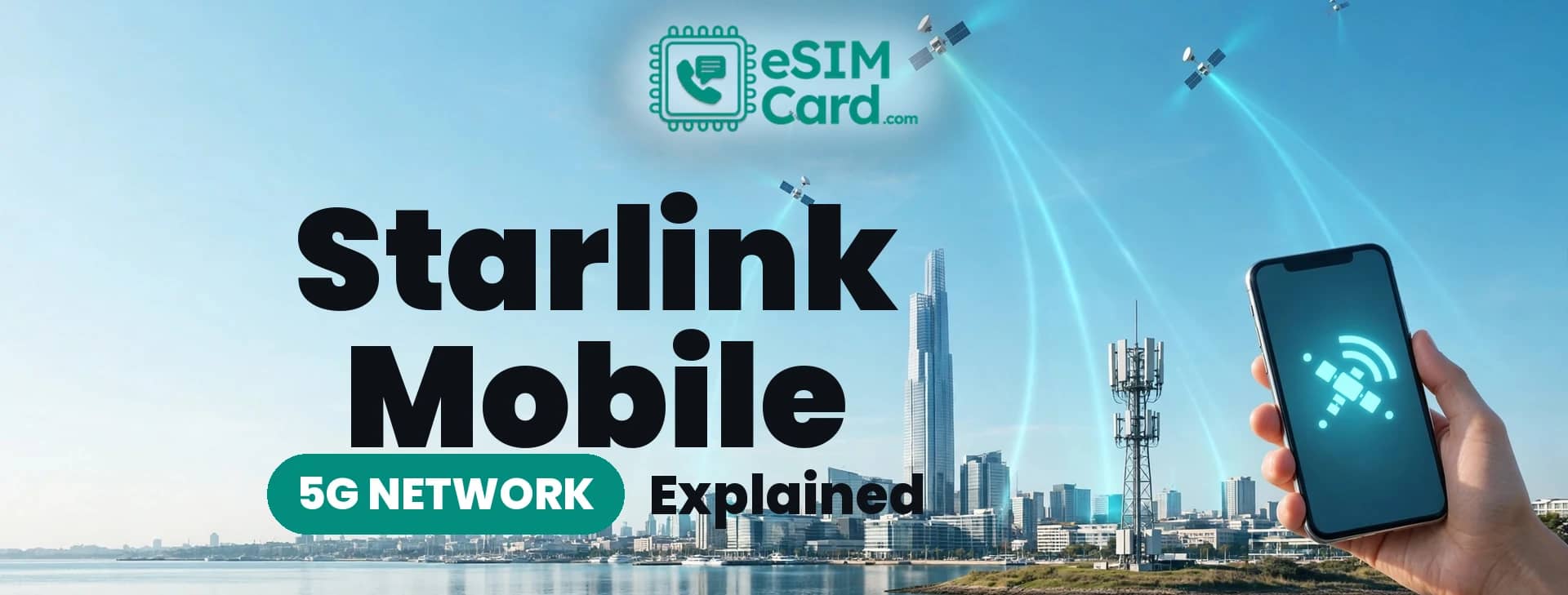
On November 4, 2026, SpaceX picked Qualcomm to power a ground-based 5G network across the United States under the Starlink Mobile name. Building starts in 2027. I read the full announcement twice, because the first read left me with the wrong impression. SpaceX has not launched a phone service. It has hired the company that will help it build one.
The short answer: Starlink Mobile is SpaceX's mobile carrier brand. On November 4, 2026, SpaceX selected Qualcomm to power a new ground-based 5G network across the US, with building starting in 2027 at tens of thousands of sites. You cannot sign up yet. The satellite phone service people use today is a different product, sold by T-Mobile as T-Satellite.
Here is what was actually announced, what already works, and what any of it means if you travel.
4.9

Highly Rated
Based on 500,000+ customer reviews

Trusted worldwide
Over 1 million travelers across the globe have trusted us

Travel Friendly
No swaps, global connectivity ensured
What SpaceX and Qualcomm Announced on November 4
Start with the confirmed facts, because plenty of coverage skips them.
SpaceX signed a multi-year agreement with Qualcomm. Under Qualcomm's announcement, SpaceX will build its terrestrial base stations on two Qualcomm Dragonwing platforms. The QRU100 handles the radio unit side, the antennas. The QDU100 handles baseband processing, the heavy signal work underneath. Qualcomm also supplies the commercial Layer 1 software the radios run on.
The radios are Massive MIMO units with 64 transmit and 64 receive paths (64T64R), the same class of hardware big carriers deploy. SpaceX plans to install them at tens of thousands of sites across the US from 2027.
What is missing matters just as much. No deal value. No first cities named. No word on consumer plans, prices, or a service launch date.
Starlink SVP Michael Nicolls described the goal as building "the first fully integrated nationwide satellite and ground network." Integrated is the whole play here: one company owning the space layer and the ground layer at once. Nobody else has tried that at national scale.
The announcement at a glance | |
|---|---|
Announced | November 4, 2026 |
Supplier | Qualcomm (Dragonwing platforms) |
Hardware | QRU100 radio units, QDU100 baseband units, Layer 1 software |
Radio setup | Massive MIMO, 64 transmit and 64 receive paths |
Sites | Tens of thousands across the US, exact number not disclosed |
Building starts | 2027 |
Deal value | Not disclosed |
Consumer launch date | Not announced |
Why SpaceX Is Buying Spectrum and Chasing Tower Sites
Radios are useless without airwaves. SpaceX has spent the past year buying those too, and this is where the real money sits.
In September 2025, SpaceX agreed to buy EchoStar's AWS-4 and H-block licenses for about $17 billion, roughly 50 MHz of 2 GHz airwaves. The FCC approved the deal in May 2026. The final transfer is expected around late 2027.
Then, on October 8, 2026, SpaceX agreed to buy up to 14 MHz of paired 800 MHz spectrum from Grain Management. The price was reported at about $8 billion. That one still needs FCC approval.
Why two very different bands? Simple physics. The 800 MHz low band travels far and pushes through walls, so it becomes the coverage layer. The 2 GHz mid band carries far more data, so it becomes the capacity layer. Every national network is built on some version of this pairing. SpaceX is following the standard playbook, just with satellites parked on top.
Bloomberg has reported talks for access to at least 80,000 US cell sites, with tower owner Crown Castle named. Treat that as reported, not confirmed. For scale, the whole US has roughly 255,000 macro sites, so 80,000 would be a serious chunk of the country's towers overnight.
And here is the part the cheerful coverage skips. DISH tried building a national network from spectrum and tower leases not long ago. It ended badly, with billions in disputed lease claims still argued over today. Leases, backhaul, and permits move slowly. Hardware announcements move fast. That gap is where this plan gets tested.
Direct to Cell, Explained in Plain English
Direct to cell means a satellite behaves like a phone tower in space, talking directly to the ordinary phone already in your pocket.
No dish. No special handset. No new SIM card. The satellite transmits on frequencies your carrier already uses, so when your phone loses every ground tower, it simply finds the satellite instead and connects the same way. The identity check happens through the SIM or eSIM profile your line already has. Engineers call the standard behind it 5G NTN (3GPP Release 17), but the plain version is the only one you need: the tower moved to orbit, your phone did not change.
Now the limits, because they are real and they shape everything below.
- It works outdoors, with a clear view of a large part of the sky. Buildings, tunnels, dense tree cover, and deep valleys break it.
- It was built for text messages and light app data. It is not for streaming, video calls, or loading your photo library.
- Messages can take a while, and a satellite pass overhead lasts only a few minutes.
- Ookla's RootMetrics testing found roughly 1 in 7 satellite direct-to-cell texts failed to go through, against about 1 in 50 on the ground network.
That last number is the one to remember. Satellite today is a backup layer. A good one, a genuinely useful one, but a backup.
What You Can Actually Use Today: T-Satellite
Here is the confusion at the center of this story. Starlink Mobile, the carrier SpaceX is building, sells nothing yet. But a SpaceX satellite phone service exists today, and you buy it from T-Mobile.
It is called T-Satellite. It runs on 650+ Starlink direct-to-cell satellites and has been live since July 23, 2025. T-Mobile includes it free on its top plans, Experience Beyond and Better Value. Everyone else pays $10 a month at limited-time pricing, including AT&T and Verizon customers. No carrier switch needed.
If you are on another carrier, the service arrives as a second eSIM line on your phone. Your main line stays exactly as it is, same number, same plan. The satellite line sits quietly next to it and only wakes up when your phone finds no ground network at all. That second line is an eSIM profile, the same technology this whole site is about. Two conditions come with it: your phone must be unlocked, and it must have a free eSIM slot. (New to the concept? Here is what an eSIM is, in plain terms.)
What works: texts, picture messages, location sharing, and data inside a short list of satellite-ready apps (WhatsApp, Google Maps, AllTrails). Texting 911 over satellite is free for anyone with a compatible phone, even if you never pay. What does not work: regular voice calls, open web browsing, anything indoors.
The phone list runs to 60+ models, including iPhone 13 and newer, Galaxy S21 and newer, and the Pixel 9 line. Coverage spans the continental US, Hawaii, Puerto Rico, and parts of southern Alaska, with partner coverage in Canada, New Zealand, and Japan.
Fact Check: There Is No "Starlink eSIM" You Can Buy
Search for Starlink eSIM and you will find pages describing a Starlink Mobile plan, complete with a monthly price and a data allowance. I have seen one version shared around forums: $30 a month, 1 TB of data. Specific. Confident. Completely made up.
SpaceX sells no SIM card and no eSIM profile to the public. Qualcomm's release mentions no plans. There is no Starlink Mobile price list, no coverage map, and no sign-up page, because there is nothing to sign up for. Any page that gives you a Starlink Mobile price today is inventing it.
The real doors are two. One, satellite backup through a carrier partner, which right now means T-Satellite. Two, a normal travel eSIM when what you need is data in another country. Neither is sold by SpaceX.
What Starlink Mobile Means for Travelers
Short version first: for your next trip, nothing. The ground network is US-only, building starts in 2027, and no service date exists. Anyone who tells you this changes your travel setup this year is guessing.
Where it does touch travel is inside the US, and only as backup. American dead zones are real: T-Mobile itself counts 500,000+ square miles with no coverage from any carrier. On a desert road trip, or a hike past the last highway, a satellite line that sends a text and shares your location is worth having. T-Satellite does that today, no waiting for 2027.
Abroad is a different story. Direct-to-cell only works where Starlink has a commercial deal with a carrier in that country, and those deals are landing country by country, at different speeds. Land somewhere without one and your phone gets nothing from those satellites, no matter how new it is. The exception people mix into this is Apple's own satellite features on recent iPhones. Those run on a different network (Globalstar) and cover emergencies and light messaging in limited countries.
And on a normal trip (cities, airports, hotels, trains), satellite adds almost nothing. It is slow, it wants open sky, and it thinks in text messages. Your actual data still comes from ground networks in the country you are visiting, which is precisely how international eSIMs work: land, connect to a local network, pay local-style prices instead of your home carrier's roaming charges. That does not change because SpaceX bought some radios.
Worth watching, but further out: if SpaceX sells its own plans around 2028, a date that has already slipped once, one line could pair ground 5G at home with satellite backup off the grid. A nice safety net. Still not a travel data plan.
Starlink Mobile vs Travel eSIM: Different Jobs
People keep framing these two as rivals. They are not, and one comparison shows why.
Starlink Mobile (future carrier) | T-Satellite (satellite backup) | Travel eSIM | |
|---|---|---|---|
Can you buy it today? | No | Yes, through T-Mobile | Yes |
Where it works | US ground network, planned | US plus Canada, New Zealand, Japan | 200+ countries and regions |
What it carries | Full mobile service, planned | Texts, location, select apps | Full data: maps, calls over data, video, uploads |
Works indoors? | Yes, on ground towers | No, needs open sky | Yes |
What it costs today | Not announced | $10/month, or included on top T-Mobile plans | Paid per trip, by data package |
A travel eSIM puts you on the same local networks residents use, with real speeds, the full difference between 5G and 4G included. A satellite line keeps you reachable when those networks do not exist at all. One is the plan. The other is the parachute.
Notice something in that table, too. The satellite backup itself now arrives on your phone as an eSIM. The delivery method won, whichever network is behind it.
Timeline: What Happens in 2027 and 2028
Keep this table. It separates the confirmed from the merely reported.
When | What | Status |
|---|---|---|
September 2025 | SpaceX agrees to buy EchoStar's AWS-4 and H-block spectrum for about $17 billion | Confirmed. FCC approved May 2026, final transfer expected late 2027 |
October 8, 2026 | SpaceX agrees to buy up to 14 MHz of 800 MHz spectrum from Grain Management | Confirmed deal. FCC approval still pending |
October 21, 2026 | AT&T and AST SpaceMobile complete the first tower-to-satellite call handoff test | Confirmed. A rival's milestone, and a sign of where the race is heading |
November 4, 2026 | SpaceX selects Qualcomm for the ground 5G network | Confirmed |
2027 | Ground deployment begins at tens of thousands of sites. Next-generation Starlink Mobile satellites start launching | Confirmed plan |
Early 2028 | First consumer service on SpaceX's own spectrum | Expected only. This date has already slipped once |
Until SpaceX publishes otherwise, treat every exact launch date and every price attached to Starlink Mobile as invented.
Going to the USA? Stay Connected from Day One!
Skip airport SIM queues. Install your US eSIM before departure and get connected when you land.

FAQs
What is Starlink Mobile?
Starlink Mobile is SpaceX's mobile carrier brand. Today it exists as a satellite direct-to-cell service run with partners like T-Mobile. From 2027, SpaceX plans to add its own ground-based 5G network in the US, built on Qualcomm hardware.
When will Starlink Mobile launch as its own carrier?
Nobody knows, and SpaceX has not said. Building starts in 2027. Outside reporting points to early 2028 for first consumer service on SpaceX's own spectrum, an estimate that has slipped before. There is no official launch date.
Can I buy a Starlink eSIM or SIM card?
No. SpaceX sells no SIM card and no eSIM profile to the public, and no Starlink Mobile plan exists anywhere. Pages listing Starlink plan prices are making them up. Your real options today are T-Satellite through T-Mobile, or a travel eSIM for data abroad.
How much will Starlink Mobile cost?
There is no price, because there is no product yet. SpaceX and Qualcomm have published nothing about plans or pricing. The only satellite phone price you can actually pay today is T-Satellite at $10 a month, or included on T-Mobile's top plans.
Will my phone work with Starlink Mobile?
For the satellite side, most recent phones already do. Direct-to-cell uses standard phone radios and your existing line, and T-Satellite alone supports 60+ models. For the future ground network, no device list exists yet, but standard 5G phones on the right bands should work.
What is the difference between Starlink Mobile and T-Satellite?
T-Satellite is a live product you can buy today from T-Mobile, using Starlink satellites as a backup connection. Starlink Mobile is SpaceX's own carrier brand, and its ground network is still being built. Same satellite family, different product, different seller.
Will Starlink Mobile replace my travel eSIM?
No. Satellite service is a text-first backup that needs open sky and only exists where carrier deals are signed. A travel eSIM gives you full data on local networks in more than 200 countries today. They solve different problems, and satellite backup itself now arrives by eSIM.
Does satellite phone service work indoors or on a plane?
No. Direct-to-cell needs a clear view of the sky, and a roof or a plane cabin blocks the signal. It is an outdoor technology. Inside a terminal or a hotel, your connection comes from ground networks and Wi-Fi, as it always has.
The Bottom Line for Your Next Trip
SpaceX is genuinely building a fourth US mobile network, and the Qualcomm deal makes that hard to wave away. But the build starts in 2027, the service has no date, and none of it touches a trip you take this year.
Traveling before then? Get your data the way that works right now. Heading to the States, set up an eSIM for the United States before you fly and land connected. Crossing several borders, take a global eSIM plan instead and skip the SIM swapping entirely. The satellites will still be there when they are ready. Your trip is happening now.