
Ava Brooks
16 Sept 2026
iPhone 18 Series: Models, Specs, Features, eSIM & Release Date
Apple's 2026 iPhone launch didn't follow the usual pattern. There was no regular iPhone 18.
Instead, Apple introduced the iPhone 18 Pro, iPhone 18 Pro Max and iPhone Duo. The Duo is Apple's first foldable iPhone, while the Pro models bring changes to the camera, battery, performance and SIM setup.
Travellers have another reason to pay attention. Apple has removed the physical SIM tray from Pro models sold in several countries. The iPhone Duo goes even further and uses eSIM worldwide.
So which model should you buy? Here's how the iPhone 18 lineup compares on price, specifications, cameras, battery, connectivity and eSIM support.
4.9

Highly Rated
Based on 500,000+ customer reviews

Trusted worldwide
Over 1 million travelers across the globe have trusted us

Travel Friendly
No swaps, global connectivity ensured
What Models Are in the iPhone 18 Series?
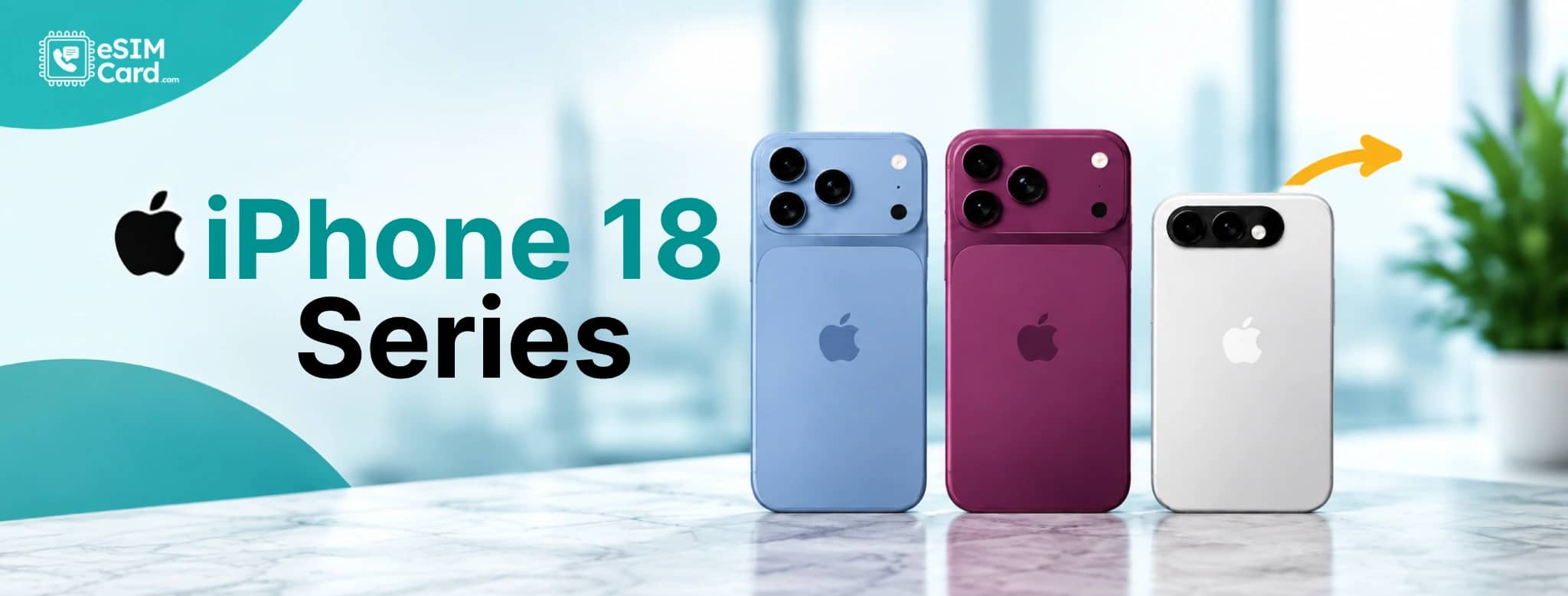
Apple announced three models as part of its iPhone lineup in September 2026: iPhone 18 Pro, iPhone 18 Pro Max and iPhone Duo.
The Pro and Pro Max keep the traditional iPhone shape. Duo folds in half, giving you a compact outer screen and a much larger display when opened.
All three use Apple's A20 Pro chip. Storage starts at 256GB and goes as high as 2TB. The bigger differences appear when you compare the displays, cameras, battery life and design.
Where Is the Regular iPhone 18?
Apple didn't announce a standard iPhone 18 on September 9, 2026.
You may see reports discussing a base iPhone 18, but Apple hasn't announced an official launch date for one. For now, the Pro, Pro Max and Duo are the confirmed 2026 models.
iPhone 18 Series Release Date: When Does It Come Out?
The iPhone 18 Pro and Pro Max arrive first. The Duo follows about a month later.
Apple opened iPhone 18 Pro and Pro Max pre-orders on September 12, with availability beginning September 18.
If you're buying one abroad, check the model sold in that country. The SIM setup can change depending on where the phone was originally purchased.
iPhone 18 Pro vs Pro Max vs Duo: What's the Difference?
The iPhone 18 Pro is the smaller traditional flagship, while the Pro Max gives you a bigger screen and longer battery life.
Duo is the foldable option, with a 7.6-inch inner screen and an eSIM-only design worldwide.
The Pro and Pro Max share most of their core hardware. Size and battery life are the main reasons to pick one over the other.
Duo is a different proposition. You're paying considerably more for the folding design and larger inner display.
iPhone 18 Series Full Specifications
If you want the main technical details in one place, here's the comparison.
Apple rates all three at IP68 for water and dust resistance. The Pro and Pro Max use aluminium unibody construction with Ceramic Shield 2 on the front. Duo uses a titanium foldable design with Ceramic Shield 2 on the front.
iPhone 18 Display and Design Comparison
Screen size is one of the clearest differences between the three phones.
The iPhone 18 Pro has a 6.3-inch Super Retina XDR OLED display with a 2622 x 1206 resolution. The Pro Max increases that to 6.9 inches and 2868 x 1320 pixels.
Both use ProMotion with adaptive refresh rates up to 120Hz. They also support Always-On display, HDR, True Tone and outdoor brightness up to 3,000 nits.
The Duo has two screens. Closed, you get a 5.4-inch OLED outer display. Open it, and you're looking at a 7.6-inch folding OLED display with a 1878 x 2670 resolution.
Both Duo displays support ProMotion up to 120Hz, Always-On display and up to 3,000 nits outdoor brightness. The inner display also supports Apple Pencil USB-C.
Size and weight
The iPhone 18 Pro measures 150 x 71.9 x 8.75mm and weighs 211g. The Pro Max measures 163.4 x 78 x 8.75mm and weighs 249g.
Duo weighs 254g. When opened, it measures just 5.2mm thick. Fold it, and the depth increases to 11.3mm.
That makes Duo the heaviest of the three, but its folding body gives you much more screen space when you need it.
iPhone 18 Camera Comparison
Apple hasn't treated the three phones equally when it comes to cameras. The Pro and Pro Max get the more advanced setup.
Both use a 48MP Pro Fusion camera system. The 48MP Fusion Main camera has variable aperture settings of f/1.48, f/1.8, f/2.8 and f/4.0. That gives photographers more control over light and depth of field.
There's also a 48MP Fusion Ultra Wide and a 48MP Fusion Telephoto. The system reaches 8x optical-quality zoom and up to 40x digital zoom.
The Duo uses a 48MP Dual Fusion system instead. It combines a 48MP Fusion Main camera with a 48MP Fusion Ultra Wide. The Main camera can also provide 2x optical-quality Telephoto. Digital zoom goes up to 10x.
If photography is high on your list, the Pro models are the stronger choice. Duo's cameras are still capable, but its real selling point is the foldable screen.
What about video?
The Pro models can record 4K Dolby Vision at up to 120 fps with the Fusion Main camera.
They also support ProRes, ProRes RAW, Apple Log 2 and external recording. The 18MP Centre Stage front camera can record 4K Dolby Vision up to 60 fps.
Duo can shoot 4K Dolby Vision up to 60 fps and supports Cinematic mode up to 4K at 30 fps. Its outer 12MP Centre Stage camera can also record 4K Dolby Vision up to 60 fps.
iPhone 18 Battery Life and Charging
The Pro Max has the longest official video playback figure of the traditional iPhones.
Apple rates the iPhone 18 Pro for up to 36 hours of video playback and 33 hours of streamed video.
The Pro Max reaches up to 45 hours of video playback and 40 hours of streamed video. Duo works differently because it has two displays and dual built-in batteries.
Apple rates it for up to 44 hours of video using the outer screen or 31 hours using the inner display. Typical use is rated at up to 24 hours.
How fast does the iPhone 18 charge?
The Pro and Pro Max can reach about 50% charge in 15 minutes with a suitable 60W or higher power adapter and USB-C cable.
Duo takes around 20 minutes to reach 50% under Apple's specified wired charging conditions.
All three support MagSafe and Qi2 wireless charging up to 25W.
iPhone 18 Connectivity: 5G, Wi-Fi 7 and USB-C
Connectivity is strong across the lineup. The iPhone 18 Pro, Pro Max and Duo support 5G, Wi-Fi 7, Bluetooth 6, NFC and USB-C. Apple's N1 wireless networking chip is also part of the 2026 lineup.
USB-C supports USB 3 transfer speeds up to 10Gb/s and DisplayPort. That matters if you regularly move large ProRes videos to a computer or connect your phone to an external display.
The phones also support precision dual-frequency GPS, which is useful for navigation when you're travelling.
What's New on the iPhone 18 Pro and Pro Max?
The A20 Pro chip sits at the centre of both phones. It uses a 6-core CPU, 7-core GPU with Neural Accelerators and a dual 16-core Neural Engine.
Apple pairs it with a next-generation vapour chamber to help maintain performance during demanding tasks.
Camera hardware is another big change. The 48MP Fusion Main camera now has a variable aperture. Instead of using one fixed opening, it can work at several aperture settings.
That gives photographers more control over depth of field and lighting. Apple has also made Dynamic Island smaller, while storage now starts at 256GB and reaches 2TB.
The Pro models come in four colours: Black, Silver, Glacier and Burgundy. Both ship with iOS 27 and support Apple Intelligence and Siri AI features.
What Is the iPhone Duo?
The iPhone Duo is Apple's first foldable iPhone. Closed, it works through a 5.4-inch outer display. Open it, and you get a 7.6-inch inner screen.
It's easy to see the travel appeal. You can have a map open beside a booking confirmation or use the larger screen for movies on a long flight.
The inner display supports Apple Pencil USB-C too. Duo runs on the A20 Pro chip and has a dual-battery design.
Apple uses Touch ID instead of Face ID, with the fingerprint sensor built into the side button. And there's no physical SIM tray.
iPhone Duo is eSIM-only worldwide. Apple says it supports two active eSIMs and can store eight or more eSIM profiles.
Emergency and Satellite Features on iPhone 18
The iPhone 18 Pro, Pro Max and Duo support Apple's safety features, including Emergency SOS via satellite, Crash Detection, Roadside Assistance via satellite, Messages via satellite and Find My via satellite.
Availability can depend on the country or region. These features can be particularly useful on road trips or in areas where normal cellular coverage isn't available.
They shouldn't replace proper emergency planning, but they're worth knowing about if you travel to remote places.
Is the iPhone 18 eSIM-Only?
Not every iPhone 18 Pro and Pro Max is eSIM-only. The answer depends on where the phone was originally sold.
Duo is simpler. It's eSIM-only worldwide.
If your model is eSIM-only, there's no nano-SIM tray. Your mobile plan is downloaded to the phone instead.
For travellers, that can save time. You can buy a travel plan online rather than finding a physical SIM shop after landing.
Your iPhone still needs to be unlocked if you want to use an eSIM from another provider.
Which countries get eSIM-only iPhone 18 Pro models?
Apple lists eSIM-only iPhone 18 Pro and Pro Max versions in:
- Bahrain
- Canada
- Guam
- Japan
- Kuwait
- Mexico
- Oman
- Qatar
- Saudi Arabia
- United Arab Emirates
- United States
- U.S. Virgin Islands
The SIM hardware is tied to the market where the phone was sold. If you buy an eSIM-only iPhone 18 Pro in the US and later take it to another country, it remains an eSIM-only phone.
That's worth checking before buying an imported model.
What does eSIM-only mean?
eSIM does the same basic job as a physical SIM, but there's no plastic card. Your carrier or eSIM provider gives you a digital profile that you install on the phone.
For international travel, this means you can keep your normal number and add another eSIM for mobile data.
Can You Use Two eSIMs on iPhone 18?
Yes. Supported iPhone 18 models can use two eSIM lines where the device, market and providers support the setup.
Think about a traveller from Canada spending two weeks in Italy. The Canadian number can stay active for texts and verification codes. A second eSIM handles mobile data in Italy.
Both plans stay on the same phone. Stored eSIMs and active eSIMs aren't the same thing, though.
Apple specifically confirms that the iPhone Duo supports two active eSIMs and stores eight or more eSIM profiles.
Can You Use a Travel eSIM on iPhone 18?
Yes. An unlocked iPhone 18 with eSIM support can use a compatible travel eSIM.
You have three common options when travelling abroad: use your home carrier's roaming service, buy a local SIM where your phone supports one or install a travel eSIM.
If you're visiting multiple destinations, an international eSIM can be a convenient option for staying connected across countries.
For an eSIM-only iPhone, the third option is usually the simplest. You can install the plan before leaving home.
When you arrive, turn the line on and use data for Maps, WhatsApp, Uber, email or hotel bookings. Check your phone's carrier-lock status before buying.
Also check that the eSIM covers your destination. Phone compatibility alone doesn't mean a plan works everywhere.
For more tips on preparing your iPhone for international travel, see our iPhone travel guide.
Stay Connected with eSIMCard on iPhone 18
If you're taking an iPhone 18 abroad, eSIMCard gives you local, regional and global eSIM options.
Before buying, look at the data allowance and validity period. Check hotspot support too if you plan to share data with a laptop or tablet.
Traveling to the United States? Explore our USA eSIM plans before your trip.
How to Install an eSIM on iPhone 18
It's best to install your travel eSIM while you still have a good Wi-Fi connection.
- Buy your eSIM plan.
- Connect your iPhone to Wi-Fi.
- Open Settings > Cellular or Mobile Service > Add eSIM.
- Scan the QR code or enter the activation details.
- Name the new line, such as Travel or Japan Data.
- Choose it as your cellular-data line.
- Turn on data roaming if your provider asks you to.
- Test the connection when you arrive.
Need more detailed setup instructions? Follow our iPhone eSIM setup guide.
Doing this before your flight makes life easier. You don't want to land after a long journey and spend the next half hour trying to scan a QR code over weak airport Wi-Fi.
Don't delete the eSIM before you're finished with it. Some activation QR codes can't be used twice.
Can You Keep Your Home Number and Use a Travel eSIM?
Yes. This is one of the most useful parts of having Dual SIM. Say you live in the UK and travel to New York.
Your UK line can stay active for texts and verification codes. A USA eSIM can handle your mobile data.
Open your cellular settings and choose the travel eSIM for data. If your home carrier charges high roaming rates, turn off data roaming for your UK line. It's also worth switching off cellular data switching.
Otherwise, the phone could fall back to your home network without you noticing. That's an easy way to turn a cheap travel-data plan into an expensive roaming bill.
Moving From a Physical SIM to an eSIM-Only iPhone 18
If your old phone uses a nano-SIM, don't erase it as soon as your new iPhone arrives. You can't move that plastic SIM into an eSIM-only model.
Your carrier needs to transfer the number to an eSIM instead. Some networks let you do this during iPhone setup. Others use a carrier app, QR code or customer support.
Keep the old phone until you've tested the new one. Make a call. Send an SMS. Try mobile data and iMessage.
If your bank sends security codes by text, test those too. Once everything reaches the new phone properly, you can wipe the old device.
iPhone 18 eSIM Problems and Quick Fixes
Most eSIM problems come down to a setting, carrier restriction or activation issue.
If you're unsure whether your eSIM was set up correctly, you can check your eSIM activation before troubleshooting further.
If your eSIM is installed but the internet isn't working, check which line is selected for cellular data first.
Then look at data roaming. Some travel eSIMs need roaming turned on because they connect through a local partner network.
Which iPhone 18 Is Best for Travel?
For most travellers, the iPhone 18 Pro is the easiest all-round choice.
The Pro gives you most of Apple's high-end features without the size of the Pro Max or the $1,999 starting price of Duo.
Pick the Pro Max if battery life and a bigger screen matter more. Duo makes sense if you'll genuinely use the folding screen.
It's great for maps, entertainment and multitasking, but you also need to be happy relying completely on eSIM.
Conclusion
The iPhone 18 lineup gives you three very different choices. The iPhone 18 Pro is the balanced option.
The Pro Max gives you the biggest traditional display and longest battery life. The iPhone Duo trades the familiar iPhone shape for a foldable 7.6-inch screen.
For travellers, check the SIM setup before buying. Some Pro and Pro Max versions don't have a physical SIM tray, while Duo is eSIM-only everywhere.
Sort out your main number before your trip and install your travel data plan while you still have reliable Wi-Fi.
With eSIMCard, you can choose a local, regional or global eSIM based on where you're going, then have your mobile data ready before you land.
FAQs
Is the iPhone 18 eSIM-only?
Some iPhone 18 Pro and Pro Max versions are eSIM-only, depending on where they're sold. The iPhone Duo is eSIM-only worldwide.
Does the iPhone 18 Pro have a physical SIM slot?
It depends on the country of sale. Models sold in markets including the US, Canada, Japan, Saudi Arabia and the UAE are eSIM-only.
Is iPhone Duo eSIM-only?
Yes. The iPhone Duo doesn't accept physical SIM cards. Apple lists Dual eSIM support with two active lines.
Can I use a travel eSIM on iPhone 18?
Yes. An unlocked iPhone 18 can use a compatible travel eSIM in supported destinations.
Can I keep my normal number with a travel eSIM?
Yes. Keep your home line active for calls or texts and choose the travel eSIM for cellular data.
Can iPhone 18 use two eSIMs?
Supported models can use two eSIM lines where the device, market and providers support the setup. Apple confirms two active eSIMs on the iPhone Duo.
How many eSIMs can iPhone Duo store?
Apple says the iPhone Duo can store eight or more eSIM profiles and keep two active at once.
How long does the iPhone 18 battery last?
Apple rates the iPhone 18 Pro for up to 36 hours of video playback and the Pro Max for up to 45 hours. Duo reaches up to 44 hours when using its outer display.
When does the iPhone 18 Pro come out?
The iPhone 18 Pro and Pro Max go on sale September 18, 2026, after pre-orders begin September 12.
How much is the iPhone 18 Pro?
The iPhone 18 Pro starts at $1,199 in the US. The Pro Max starts at $1,299.
Which iPhone 18 has the best camera?
The iPhone 18 Pro and Pro Max have the strongest camera setup. Both include a 48MP Fusion Main, 48MP Ultra Wide and 48MP Fusion Telephoto camera with up to 8x optical-quality zoom.
Which iPhone 18 is best for international travel?
The iPhone 18 Pro should suit most travellers because it combines a smaller body with Pro cameras, strong battery life and eSIM support. Duo is worth considering if you want a foldable display and to keep several eSIM profiles.