
Emma Sky
01 Aug 2026
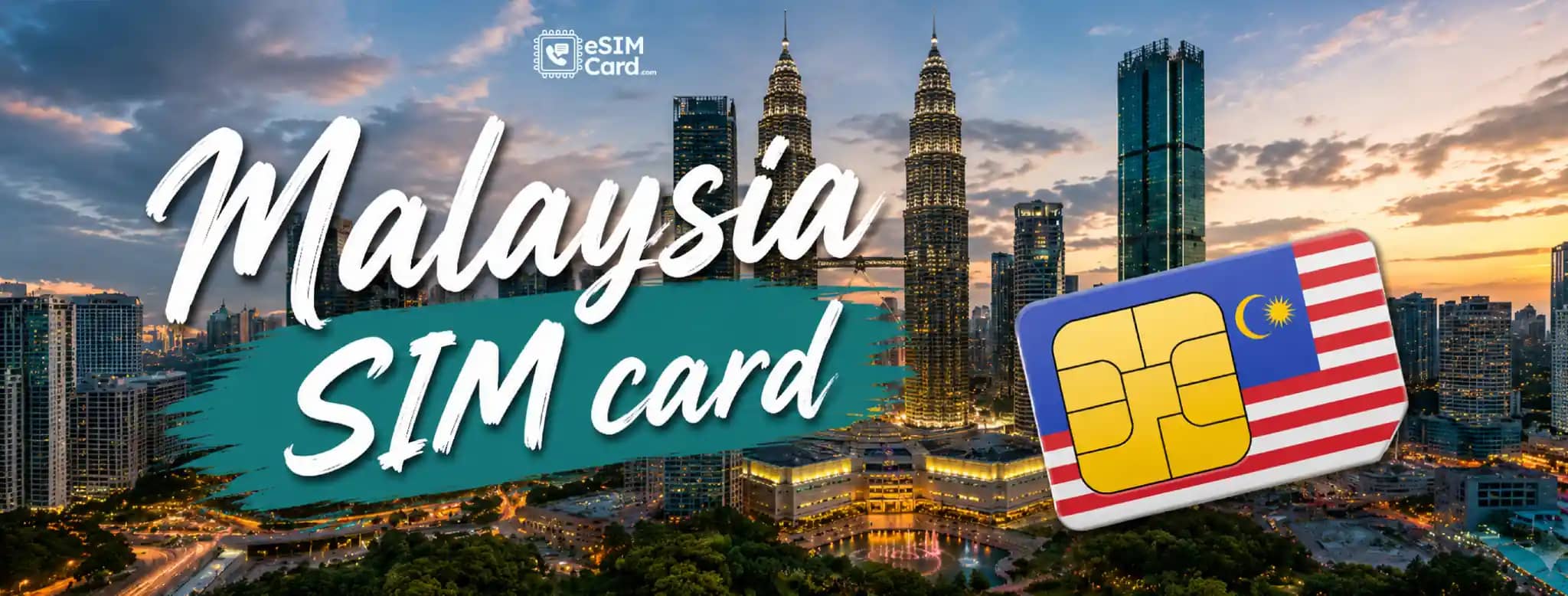
Malaysia SIM Card: Best Options for Tourists in 2026
Land in Kuala Lumpur and you'll probably need mobile data before you even leave the airport.
Grab needs an internet connection. Google Maps has your hotel location. WhatsApp may hold your booking details.
Meanwhile, your home SIM could start charging international roaming rates as soon as mobile data turns on.
A Malaysian SIM card is one of the easiest ways to get around that problem. CelcomDigi, Maxis Hotlink and U Mobile all offer prepaid plans for international visitors.
Prices are low, data allowances are generous and short-term packages are easy to find. There's another option too. Travelers with an eSIM-compatible phone can buy a Malaysia eSIM before flying and connect without replacing their physical SIM.
Which one makes sense? It comes down to price, convenience, coverage, and whether you need a Malaysian phone number.
4.9

Highly Rated
Based on 500,000+ customer reviews

Trusted worldwide
Over 1 million travelers across the globe have trusted us

Travel Friendly
No swaps, global connectivity ensured
Do you need a SIM card for Malaysia?
Most visitors need either a prepaid Malaysia SIM card or a travel eSIM unless their home plan already includes affordable roaming.
Hotel and cafe Wi-Fi can cover part of your trip. It won't help much when you're outside KLIA booking Grab, finding a restaurant in George Town or checking directions in Langkawi.
Mobile data is useful for Google Maps, Grab, WhatsApp, banking apps, translation, bookings and social media.
A local prepaid SIM usually gives you the lowest price per GB. A travel eSIM costs more in some cases, but you can install it before arriving and keep your normal SIM inside the phone.
A week in Kuala Lumpur is very different from a month split between Peninsular Malaysia, Sabah and Sarawak. Your route matters.
Requirements to get a Malaysia SIM card as a tourist
Foreign tourists can buy prepaid SIM cards in Malaysia, but passport registration is required for local prepaid service. The Malaysian Communications and Multimedia Commission (MCMC) requires mobile operators to verify customer identity as part of the country's prepaid SIM registration framework.
Malaysia's prepaid registration framework identifies foreign visitors using passport details. Official MCMC material also describes automated registration processes using identity document scanning and biometric technology.
Tourist registrations have historically been subject to limited validity, so check the latest operator requirements when purchasing. Rules can change, and the mobile operator must follow current MCMC requirements.
Bring your original passport rather than assuming a photo or photocopy will be accepted. You should have an unlocked phone. A network-locked handset can reject another operator's SIM even when the SIM itself is active.
Buying from an official CelcomDigi, Maxis Hotlink or U Mobile location can make registration easier because staff can complete activation and test the connection.
A travel eSIM takes a different route. For example, eSIM Card's Malaysia eSIM is sold online, and its current product information states that ID or eKYC isn't required for its travel data plans. The eSIM is delivered digitally instead of being registered as a Malaysian local prepaid SIM.
How much does a SIM card cost in Malaysia?
A tourist SIM card in Malaysia can currently cost from about RM6 to RM64, depending on validity, data allowance and provider.
That's one reason local prepaid service is attractive here. Even large data allowances can cost less than a single day of international roaming from some overseas carriers.
U Mobile currently advertises a 100GB seven-day tourist package for RM15. Its July 2026 launch announcement also bundles that plan with a Grab Visit Malaysia 2026 Travel Pass.
Prices were checked in July 2026. Mobile operators change plans and promotions regularly, so check the current rate before paying.
And watch that word unlimited. An unlimited package may still have a Fair Usage Policy, or FUP. Once you pass the high-speed allowance, the network may apply speed throttling instead of cutting off your data completely.
Best prepaid SIM cards in Malaysia
For most tourists, the shortlist comes down to CelcomDigi, Maxis Hotlink and U Mobile.
Other prepaid brands such as Tune Talk also operate in Malaysia, but the three larger options are easier to compare for short tourist stays.
CelcomDigi Tourist SIM
CelcomDigi gives tourists several validity choices, making it useful when your trip doesn't fit a simple seven-day package.
Current tourist options include short and longer passes. Some combine unlimited usage with an FUP, while longer packages provide large high-speed allowances.
Certain CelcomDigi tourist packages also include limited ASEAN roaming. That can help if Malaysia is one stop before Singapore, Thailand or another nearby country.
Official tourist SIM locations include Kuala Lumpur International Airport, Penang International Airport and Kota Kinabalu International Airport.
Maxis Hotlink Travel SIM
Hotlink is particularly interesting for travelers visiting several nearby countries.
Its tourist packages currently cover Malaysia, Singapore, Thailand and Indonesia. The plans include hotspot use and domestic calling within Malaysia.
Current options include:
- RM25 for seven days with a 40GB FUP
- RM35 for 15 days with a 100GB FUP
- RM64 for 30 days with a 400GB FUP
The RM35 travel option can also be purchased as a local Hotlink eSIM. Remember that the FUP is part of the package. “Unlimited” does not mean unlimited full-speed data with no threshold.
U Mobile Tourist SIM
U Mobile is the obvious one to check when budget matters. Its current seven-day tourist package provides 100GB for RM15. U Mobile has also been expanding its own ULTRA5G network and announced that it reached 80% coverage of populated areas by March 2026.
Coverage expansion has included Sabah. U Mobile reported wider ULTRA5G availability around Kota Kinabalu, Tuaran, Beaufort and Kudat in February 2026.
That doesn't mean every remote location has the same signal strength. Always check your exact route.
Which Malaysia SIM has the best coverage?
There isn't one network that's automatically best everywhere in Malaysia. Your route should decide the winner.
Kuala Lumpur, Penang and Johor Bahru are easier. Major operators have broad 4G and growing 5G availability across populated areas.
Remote islands, mountains and parts of Sabah or Sarawak deserve more planning.
Malaysia's 5G setup is also changing. Digital Nasional Berhad, or DNB, remains part of Malaysia's 5G infrastructure, while U Mobile has developed the country's second 5G network under the dual-network model. U Mobile reported reaching 80% coverage of populated areas in March 2026.
Maxis currently directs customers to a network map that includes 5G coverage information supplied by DNB. Maxis also warns that actual reception varies with terrain, buildings, devices and network conditions.
U Mobile provides its own live coverage map for ULTRA5G and 4G, with the same sensible warning: a coverage map is an estimate, not a promise that every room, beach or mountain road will have a strong signal.
That's why picking a SIM based only on 500GB is a mistake. Huge data allowances don't matter when your phone can't find a usable network.
Where can you buy a Malaysia SIM card?
You can buy prepaid tourist SIMs at airports, operator stores and selected authorized retailers.
Kuala Lumpur International Airport
KLIA and KLIA2 are the easiest places to get connected immediately after your flight.
CelcomDigi and Hotlink have tourist purchase options at Kuala Lumpur International Airport. Airport staff are also used to passport registration and tourist activations.
Convenient? Absolutely. Cheapest? Not always. Airport offers can differ from city promotions, so compare the package before paying.
Operator stores and shopping malls
Official CelcomDigi, Maxis and U Mobile outlets are common in larger Malaysian cities.
Buying from an operator store is useful when you want someone to activate the SIM, check your phone and confirm mobile data works.
Convenience stores and phone retailers
Starter SIM packs may be available through convenience stores and authorized phone sellers.
Before buying, ask whether tourist registration can be completed there. A cheap SIM isn't a bargain if you still have to visit another store for activation.
Buy an eSIM online before flying.
Don't want another airport stop? Buy a travel eSIM before departure.
You can install it while you're still connected to home Wi-Fi, label the line “Malaysia” and leave it ready for arrival.
No plastic SIM. No SIM ejector pin. No worrying about where you put your home SIM.
eSIM vs physical SIM for Malaysia: Which should you choose?
Choose a local Malaysian SIM when price or a local number matters most. Choose a travel eSIM when setup speed and convenience matter more.
A local operator eSIM and a travel eSIM are not the same thing. Hotlink and U Mobile sell local mobile service through eSIM on supported devices. You still become their prepaid customer and follow their activation requirements.
An international travel eSIM is aimed at visitors who mainly want mobile data. eSIM Card's Malaysia plans are data-only, so they don't provide a Malaysian phone number, standard voice minutes, or SMS. Internet apps such as WhatsApp and FaceTime can still work through mobile data.
That makes a travel eSIM appealing when you want to keep your home SIM available for OTPs while using a separate line for Malaysian data.
If you're deciding between the two, our guide on eSIM vs physical SIM explains the key differences, advantages, and trade-offs to help you choose the best option for your trip
How to stay connected with an eSIM in Malaysia
An eSIM gives you mobile data without removing your existing physical SIM. For many travelers, that's the whole appeal.
You can buy an eSIM before departure, install it over Wi-Fi, and keep it inactive until you're ready to use it.
eSIMCard currently lists both fixed-data and unlimited plans for Malaysia. Its product information says activation begins when the first byte of data is consumed.
A sensible setup looks like this:
- Buy a Malaysia plan that matches your trip length.
- Install the eSIM using the provided method.
- Label the line “Malaysia.”
- Select it as your mobile-data line after arrival.
- Turn on data roaming for that travel eSIM if the instructions require it.
- Keep data roaming switched off on your home SIM.
Your normal SIM can remain available for incoming SMS and bank OTPs when your phone supports Dual SIM operation.
Check the unlimited-plan wording too.
eSIMCard explains that its unlimited bundles include a full-speed allowance within every 24 hours. After that allowance is used, speeds may be reduced until the allowance resets. That's speed throttling, not a complete loss of service.
How to check whether my phone is eSIM compatible
Check eSIM support and carrier-lock status before buying any eSIM. Many newer iPhones, Samsung Galaxy devices and Google Pixel phones support eSIM, but compatibility can differ by model and country of sale.
For an iPhone, open: Settings > Cellular or Mobile Data > Add eSIM
On many Samsung Galaxy phones: Settings > Connections > SIM Manager > Add eSIM
On Google Pixel: Settings > Network & Internet > SIMs
You can also dial *#06#.
If the phone displays an EID, that's a strong sign that eSIM hardware is available. Still, don't stop there. Some eSIM-compatible phones are locked to a mobile carrier. Check the exact model and lock status before paying for a plan.
How much mobile data do you need in Malaysia?
Most tourists don't need hundreds of gigabytes. Maps, Grab and messaging use far less data than streaming video, tethering a laptop or uploading large files.
These are rough planning ranges, not fixed daily requirements. Download Netflix shows and offline maps on hotel Wi-Fi, and you'll use less mobile data.
Spend an evening streaming HD video over 5G and things change quickly. Unlimited plans can be convenient when you don't want to keep watching a data counter. Just read the FUP before buying.
Can you use a Malaysia SIM in Singapore, Thailand or Indonesia?
Yes, some Malaysian tourist plans include regional roaming, but the allowance differs by provider and package.
Hotlink currently markets Travel SIM packages for Malaysia, Singapore, Thailand and Indonesia.
CelcomDigi also includes ASEAN roaming allowances with selected tourist plans.
Read the numbers carefully.
A package that “works in Thailand” might give you only a few gigabytes there, even when your Malaysian allowance is much larger.
Visiting several Asian countries? Compare separate country plans with an eSIM before deciding.
What happens when your Malaysia SIM runs out of data?
Running out of high-speed data doesn't always mean buying another SIM.
Most prepaid operators let customers top up, recharge or purchase another data pass through their app or account.
Hotlink customers, for example, can purchase extra internet options through its app on supported plans.
With an eSIM, the process depends on the provider.
Some travel eSIM services support top-ups on the existing profile, which means you don't need to install another eSIM every time you need more data.
Check the plan before purchase because top-up availability can differ between packages.
Conclusion
Choose a local Malaysia SIM when you want the cheapest data, a Malaysian number, or traditional local mobile service.
Pick a Malaysian eSIM when you'd rather set things up before departure, keep your main SIM inside the phone, and start using data shortly after arrival.
For travelers who don't need a local number, eSIMCard offers Malaysia travel data plans that can be installed digitally before the trip.
There's no universal winner here. A RM15 local SIM can be perfect for one traveler. Someone else will happily pay for the convenience of having their data line sitting on the phone before the plane even lands.
Choose based on your route, phone, and actual data habits. That's the comparison that matters.
This version fixes the specific problems identified in the mistake file while keeping the article focused instead of padding it with extra sections.
FAQs
Can tourists buy a SIM card in Malaysia?
Yes. International visitors can buy prepaid SIM cards from Malaysian operators such as CelcomDigi, Hotlink and U Mobile. You'll need to complete the provider's tourist registration process for local prepaid service.
Do I need a passport to buy a SIM card in Malaysia?
Yes, Foreign tourists should carry their original passport when registering a local Malaysian prepaid SIM. The operator uses your identification details to complete required prepaid registration.
Can I buy a SIM card at Kuala Lumpur Airport?
Yes, tourist SIM packages are available at both KLIA and KLIA2. Buying at the airport is convenient because staff can usually help with registration and activation before you leave the terminal.
How much does a tourist SIM card cost in Malaysia?
Tourist SIM options currently start from around RM6, while common seven-day packages cost roughly RM15 to RM25. Longer packages with much larger data allowances can reach around RM50 to RM64.
Is it better to get a SIM card or eSIM in Malaysia?
A physical SIM is usually better if you want very low local pricing or a Malaysian phone number. An eSIM is more convenient when you want data prepared before arrival without removing your home SIM.
Which network has the best coverage in Malaysia?
No single provider is best in every part of Malaysia. Check CelcomDigi, Maxis Hotlink and U Mobile coverage for the exact areas you're visiting, especially in Sabah, Sarawak, islands and rural locations.
How much data do I need for a trip to Malaysia?
Around 1 to 2GB per day can cover maps, messaging and light browsing for many travelers. Streaming, hotspot use and frequent video uploads can push usage beyond 4GB per day.
Can I keep receiving OTPs while using a Malaysia eSIM?
Usually, yes, when your phone supports Dual SIM operation. Keep your home line active for SMS and use the Malaysia eSIM as your mobile-data line.
Does Malaysia have 5G?
Yes. Malaysia has widespread 5G service across populated areas, with DNB and U Mobile playing roles in the country's current dual-network structure. Your actual speed still depends on the operator, phone, location, plan and network traffic.
Can I use a Malaysian SIM in Singapore or Thailand?
Some tourist SIM packages include regional roaming in Singapore, Thailand and other ASEAN countries. Check the roaming data allowance separately because it may be smaller than your Malaysian domestic allowance.
What happens if my Malaysia SIM runs out of data?
You can usually recharge, top up or purchase another data pass through the operator's app. Check whether your package supports extensions before your original allowance expires.