
Emma Sky
18 Aug 2026
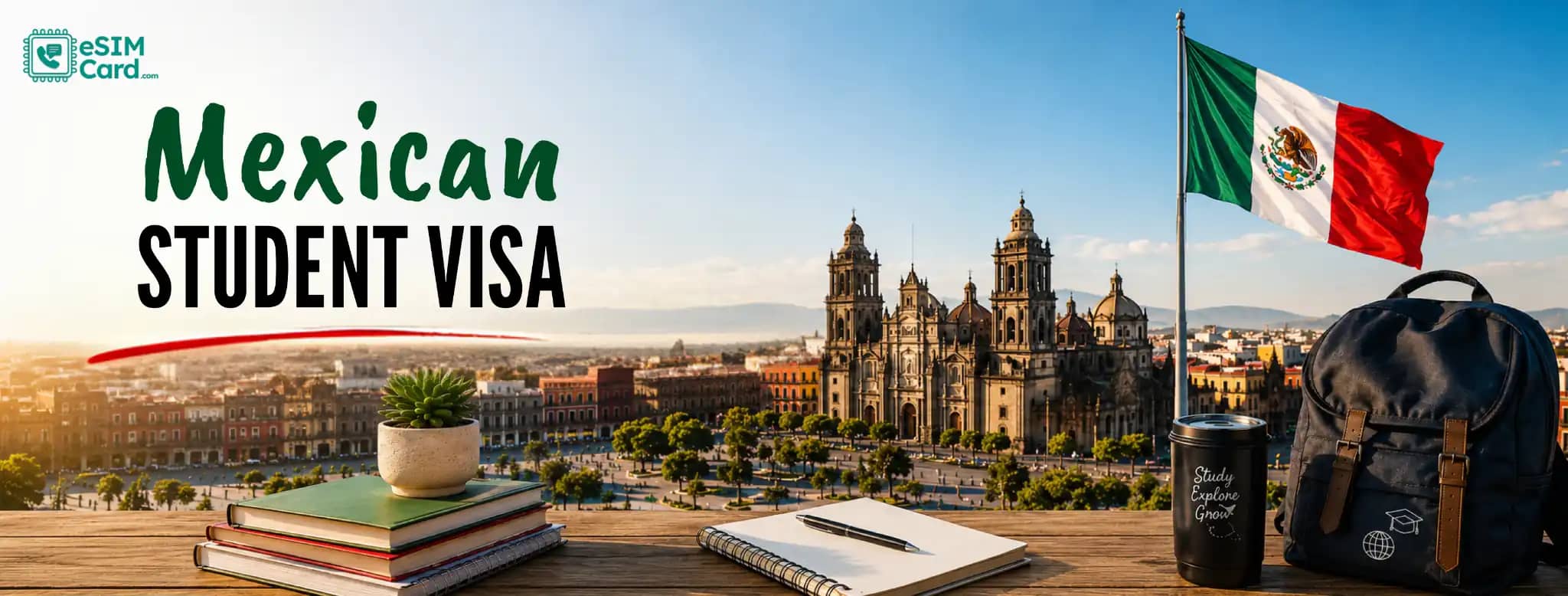
Mexico Student Visa 2026: Requirements, Cost and Steps
A university acceptance letter feels like the hard part. Then the visa checklist arrives.
For studies lasting more than 180 days, you’ll normally need a Mexico student visa before travelling.
Its official Spanish name is Visa de Residente Temporal Estudiante, or Temporary Resident Student Visa.
The visa isn’t your final residence document. It lets you travel to Mexico and request entry. After arrival, you have 30 calendar days to exchange it for a Temporary Resident Student Card through the Instituto Nacional de Migración.
That second step catches many students off guard. Mexico’s visa rules are national, but consulates can ask for different copies, payment methods, or supporting records.
Use this guide to prepare, then check the instructions published by the consulate handling your application.
4.9

Highly Rated
Based on 500,000+ customer reviews

Trusted worldwide
Over 1 million travelers across the globe have trusted us

Travel Friendly
No swaps, global connectivity ensured
Do You Need a Student Visa for Mexico?
You usually need a Temporary Resident Student Visa when your course, degree, or research program lasts more than 180 days.
The category covers foreign students accepted by institutions within Mexico’s Sistema Educativo Nacional.
It can apply to technical education, university degrees, postgraduate study, research, and formal academic exchanges.
Still comparing destinations before enrolling? Our guide to study abroad destinations compares popular options for international students.
A course lasting 180 days or less may fall under short-stay visitor rules. Your nationality still affects whether you need a visitor visa.
Don’t choose a visa based only on the label used by your school. Confirm the program dates shown on your acceptance letter.
Key Mexico student visa terms
Mexico Student Visa Requirements
The exact Mexico student visa requirements can differ slightly between consulates. One office may ask for extra copies, while another may have a specific photograph or payment rule.
Start with the checklist from the consulate where you’ll attend your interview.
Police certificates and medical reports aren’t universal requirements on the central student visa guidance. Don’t pay for them unless your consulate or university requests them.
Bring originals and copies in the order shown on the local checklist. A tidy file won’t decide your case, but it makes the interview easier.
What Should the Acceptance Letter Include?
A casual acceptance email may not be enough for a visa application. Your school should issue a formal letter on official letterhead.
The details need to match your passport and application form exactly.
Check the small details. A missing end date or incorrect passport number can slow down a clean application.
Ask the school to correct errors before your consular appointment. Don’t take a separate email and hope the officer accepts it as a fix.
How Much Financial Proof Do Students Need?
Mexico doesn’t publish one universal bank balance for every student in every country. The required amount can depend on your consulate’s formula, local currency values, and current exchange rates.
Use the current financial instructions from your own consulate.
Parents or legal guardians may show financial solvency when the student is not over 25, subject to the consulate’s document rules.
Applicants over 25 should ask which sponsorship evidence is accepted.
Students also need to budget for their actual stay. If Monterrey is your destination, our Monterrey living costs guide breaks down rent, food, transport, utilities and typical student expenses.
A last-minute deposit can raise questions. Consular officers may review account history, regular income, and who owns the funds. Make the funding story easy to follow.
If your father is paying, the sponsor letter, bank statements, and interview answers should all say the same thing.
How to Apply for a Mexico Student Visa
The Mexico student visa application normally starts at a Mexican embassy or consulate outside Mexico.
Here’s the cleanest order to follow:
- Get admitted to a recognised institution. Request a formal letter with your program dates, tuition, and study level.
- Find the correct consular office. Some offices only accept applicants who live within their service area.
- Read the local checklist. Confirm financial rules, photograph size, copies, translations, and payment instructions.
- Book through the official MiConsulado appointment system. Many Mexican consulates use it for visa scheduling.
- Prepare your file. Keep originals and copies in the same order as the checklist.
- Attend the interview in person. You’ll submit records, provide biometric data, and answer questions.
- Pay the application fee. Payment covers the review and doesn’t promise approval.
- Wait for the decision. The stated maximum decision period can reach 10 working days.
- Check the visa details. Review your name, passport number, category and validity before leaving.
- Prepare for border control. Carry your acceptance letter, Mexican address and funding records in your hand luggage.
Appointments are personal. Don’t pay someone who promises a guaranteed slot or guaranteed visa.
What happens during the visa interview?
The officer wants to confirm three things: you’re a genuine student, your documents make sense, and you can support yourself.
Questions often cover your school, course dates, funding, accommodation and plans after study. You may also be asked whether you understand your work restrictions.
Answer naturally. Don’t memorise a polished speech. Suppose your application says your mother is sponsoring you.
Claiming that you’re fully self-funded during the interview creates a needless contradiction.
Mexico Student Visa Processing Time and Cost in 2026
Mexico’s Secretaría de Relaciones Exteriores, known as the SRE, lists the 2026 student visa application fee as $56.
This fee covers the receipt and review of your application. It may not be refunded if the visa is refused.
The 10-working-day period doesn’t include the time spent waiting for an appointment. During busy admission months, securing a slot may take longer than the decision.
Apply well before your program starts. But don’t buy a non-refundable flight just to make the file look stronger. A ticket doesn’t speed up the decision.
Student Residence Card in Mexico After Arrival
Your consular visa is normally valid for one entry and up to 180 calendar days. It is used to enter Mexico and begin the residence process.
The Instituto Nacional de Migración, or INM, requires students to request their Temporary Resident Student Card within 30 calendar days of entering Mexico. The exchange is handled by the INM and is commonly called canje.
The INM may collect your photograph, signature and fingerprints. Some offices require an online appointment before you attend.
Start early. Day 29 is a bad time to discover that the next appointment is full. Your residence card controls your legal stay after the exchange. Follow the expiry date printed on that card.
Can International Students Work, Renew or Bring Family?
Can you work on a Mexico student visa?
Work permission isn’t automatic. A Temporary Resident Student may apply to the INM for permission to work.
The route is generally limited to higher education, postgraduate study and research. You’ll usually need a valid student residence card, a formal job offer and written approval from your school.
The proposed work should relate to your studies. Don’t start paid work while approval is pending.
If you’re considering staying in Mexico for remote work rather than full-time study, our Mexico digital nomad visa guide explains the alternative residence route, requirements and costs.
Can you renew student residence?
Student residence can normally be renewed while you remain enrolled in qualifying studies.
The INM may request your current card and a letter confirming that your studies continue. Apply before the card expires.
Can your family come with you?
Family unity rules may allow a spouse, partner, child or parent to apply for temporary residence.
They don’t receive student status automatically. Each person may need a separate application, relationship evidence and extra financial proof.
Ask the relevant consulate which route applies before booking appointments.
Why Student Visa Applications Get Delayed
Most problems aren’t dramatic. They’re ordinary mismatches hiding in a stack of papers.
Common examples include:
- An acceptance letter with no program end date
- A bank statement that doesn’t show the account holder
- Different spellings of the applicant’s name
- A large unexplained deposit
- Missing proof of legal stay
- An appointment booked under the wrong category
- Interview answers that conflict with the documents
- Requirements copied from a different consulate
Read the full file from an officer’s perspective.
Who’s paying? Where will you study? When does the course finish? Every document should give the same answer.
A visa can also be refused. No website, agent or school can promise approval.
Mexico eSIM for International Students
Mobile data helps from the moment you land. You may need maps, university messages, accommodation contacts, or directions to an INM office.
A Mexico eSIM lets you connect without visiting a physical SIM shop. With eSIMCard, you can buy a plan and install it on a compatible phone using a QR code.
Check that your phone supports eSIM and isn’t carrier-locked. Dual-SIM users can keep their home number available for banking codes while using an eSIMCard Mexico plan for mobile data.
If your studies or holidays also take you into the United States or Canada, a North America eSIM can cover Mexico, the USA and Canada with one regional plan.
How to Check If Your Phone Is eSIM Compatible
The quickest way to check eSIM compatibility is to look for an Add eSIM, Set Up eSIM, or Download a SIM option in your phone’s settings.
On an iPhone
- Open: Settings > Cellular or Mobile Service > Add eSIM
- You can also open: Settings > General > About
- Scroll down and look for an EID number. An EID identifies the phone’s built-in eSIM hardware. If an EID appears, the iPhone supports eSIM.
On a Google Pixel
- Open:Settings > Network & Internet > SIMs > Add SIM > Set Up an eSIM
- To check for an EID, go to: Settings > About Phone > SIM Status
- An EID listed there confirms that the device contains eSIM hardware.
On a Samsung Galaxy phone
- Open:Settings > Connections > SIM Manager
- Look for Add eSIM. Samsung identifies this menu as the quickest way to check eSIM support on a Galaxy device.
Conclusion
Your paperwork should tell one clear story. Match your name, dates, school and funding across every document. Keep the acceptance letter and financial records in your hand luggage.
After arrival, put the 30-day INM deadline at the top of your list. That step changes your entry visa into the residence card used during your studies.
Then sort out the practical details. Save your university contact, Mexican address, and immigration records offline.
Set up your eSIMCard plan before the flight if you want mobile data when you land.
FAQs
How much bank balance is required for a Mexico student visa?
Mexico doesn’t set one universal bank balance for every applicant. The required amount and accepted calculation can vary by consulate. Check the current solvency rules published by the office handling your application.
What is the difference between a Mexico student visa and a residence card?
The visa lets you travel to Mexico and request entry. The Temporary Resident Student Card proves your legal student status after arrival. You must apply for the card through the INM within 30 calendar days of entering Mexico.
Is the Mexico student visa single-entry?
The consular Temporary Resident Student Visa is generally valid for one entry and up to 180 calendar days. After entry, you exchange it for your student residence card.
Do US, UK, Canadian or EU students need a Mexico student visa?
Nationality may change short-stay visitor rules. It doesn’t remove the long-term student residence requirement. Students planning to study for more than 180 days normally need the Temporary Resident Student Visa.
Can parents sponsor a Mexico student visa?
Yes, parents or legal guardians may provide financial proof when the student is not over 25, subject to local document requirements. The consulate may ask for a sponsor letter, bank records, and proof of relationship.
Can you apply for a student visa inside Mexico?
The long-term student visa is normally requested through a Mexican consulate outside Mexico. Don’t assume you can enter as a visitor and switch after arrival. Get case-specific advice before travelling.
Do you need health insurance for a Mexico student visa?
Health insurance isn’t listed as a universal requirement in the central student visa guidance. Your school or consulate may still ask for it, so check both.
Can a Mexico student visa be refused?
Yes. Approval isn’t guaranteed. Missing records, inconsistent information, weak financial evidence, or doubts about the study purpose can affect the decision.
Does a student visa guarantee entry into Mexico?
No. The visa lets you travel to a Mexican port of entry and request admission. Immigration officers make the final entry decision after reviewing your documents and travel purpose.
How early should I apply for a Mexico student visa?
Apply as soon as your acceptance letter and financial records are ready. Appointment waiting times may add several weeks before the official decision period begins.
What if my course lasts exactly 180 days?
A course lasting exactly 180 days may follow short-stay visitor rules. Your nationality and the instructions from your Mexican consulate still decide the correct application route.