
Emma Sky
31 Jul 2026
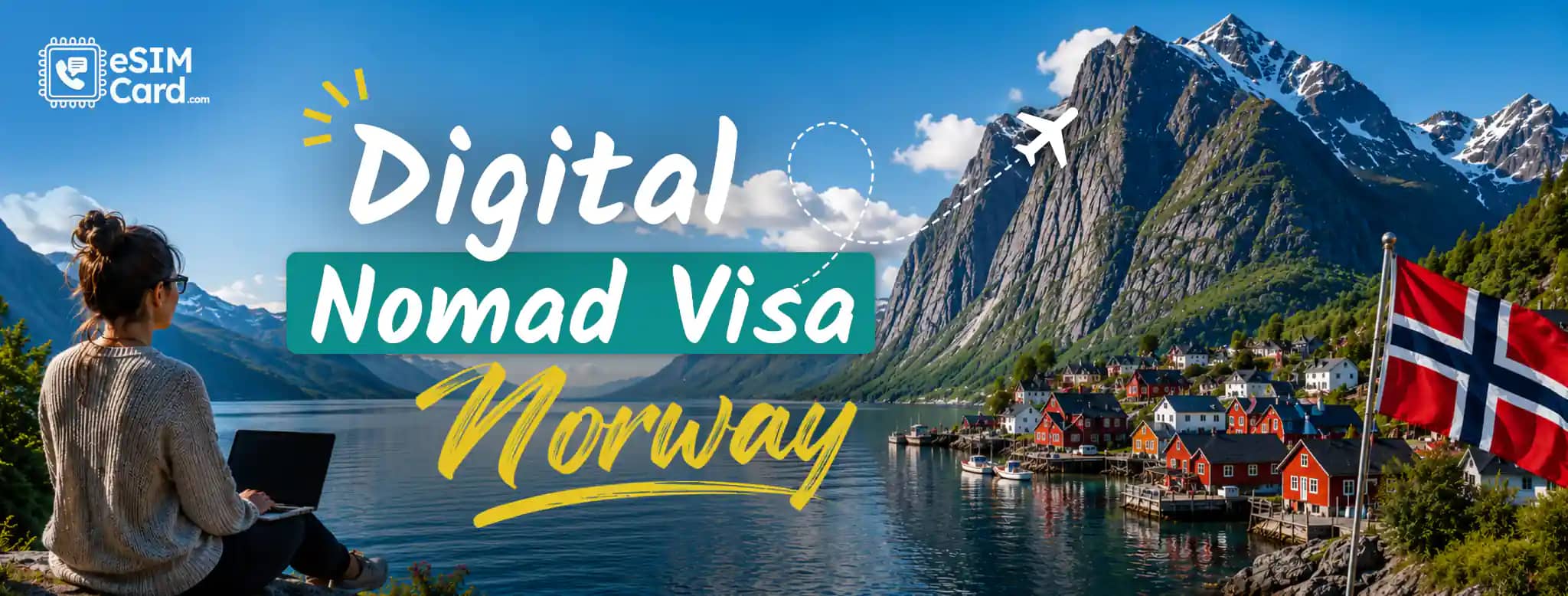
Norway Digital Nomad Visa: Requirements, Cost and Rules 2026
Norway appears on plenty of digital nomad visa lists. There is one catch. The country doesn’t offer an official permit under that name.
For some non-EU and non-EEA freelancers, the closest option is a skilled-worker residence permit for a self-employed person with a company abroad. That route is narrower than most digital nomad visas.
You normally need professional qualifications, an established business abroad and a skilled assignment from a Norwegian company. Keeping your foreign job while working from an Oslo apartment usually isn’t enough.
Once the legal side is sorted, there’s also the practical setup. Housing, taxes, and reliable internet can make or break a remote stay. A Norway Digital SIM can help you get mobile data after landing while keeping your usual SIM inside your phone.
4.9

Highly Rated
Based on 500,000+ customer reviews

Trusted worldwide
Over 1 million travelers across the globe have trusted us

Travel Friendly
No swaps, global connectivity ensured
Norway Digital Nomad Visa: Does It Actually Exist?
No, Norway doesn’t have an official digital nomad visa. People use the term because it matches what remote workers search for. Norway’s official immigration system uses different permit categories.
The closest route for many non-EU and non-EEA contractors is the skilled-worker permit for a self-employed person with a company abroad.
This permit doesn’t let anyone move to Norway simply because they earn money online. The work must normally relate to a specific assignment for a Norwegian business.
EU and EEA citizens follow different rules. They have the right to live and work in Norway under EU and EEA regulations, although registration may be required for longer stays.
If you're looking for countries with more flexible long-stay options for remote workers, our Mexico Digital Nomad Visa guide explains one of the most popular alternatives.
Who Qualifies for Norway’s Remote-Work Permit?
The relevant permit is aimed at skilled independent contractors, not every remote employee. You may be a possible fit when you:
- Own an established business outside Norway.
- Operate through a sole proprietorship.
- Have higher education, vocational training, or equivalent professional experience.
- Hold a contract for skilled work with a Norwegian company.
- Receive pay that isn’t poorer than normal Norwegian rates
- Plan to work only within the approved assignment.
The foreign business must normally be your own sole proprietorship. UDI states that this business cannot be a limited company for this permit route.
Your Norwegian client must also be a genuine business. The assignment should require your professional qualifications and normally relate to one specific enterprise.
A likely applicant
A Canadian software consultant owns a registered sole proprietorship. A Norwegian technology company hires her for a one-year cybersecurity project.
Her education and experience match the work. The contract lists the duties, payment, and project dates.
Someone who probably needs another route
A US marketing employee wants to move to Bergen while keeping the same full-time job with an American company.
There is no Norwegian assignment. In that case, this self-employed contractor permit would normally not fit.
What Are the Norway Digital Nomad Visa Requirements?
The exact documents depend on your nationality, qualifications,s and submission location. UDI provides a personalised checklist after the online application. Use that checklist as the final authority.
Your assignment contract should describe the work properly. A one-line agreement saying remote consulting services won’t tell UDI much.
Include the project scope, location, dates, payment terms, and required qualifications. If the profession is regulated, you may also need Norwegian recognition or authorization.
UDI publishes a separate checklist for independent contractors with a company abroad. Applicants also receive a checklist based on their individual application.
How to Apply for the Norway Digital Nomad Visa
There’s no application button called digital nomad visa. Start with the skilled-worker on the UDI website.
You can also review the official Skilled Workers guidance from the Norwegian Directorate of Immigration (UDI) to confirm the latest eligibility requirements, application steps and document checklist before submitting your application.
- Check whether EU, EEA, or non-EU rules apply to you.
- Open UDI’s skilled-worker permit guidance.
- Select the category for a self-employed person with a company abroad.
- Confirm that your qualifications match the Norwegian assignment.
- Secure a detailed contract from a Norwegian business.
- Ask the client to complete any required assignment confirmation.
- Complete the online application.
- Pay the residence permit fee.
- Download your personal document checklist.
- Book your appointment with the relevant embassy, police office or visa application centre.
- Submit your passport, documents and biometrics.
- Wait for approval before starting work that requires the permit.
If you apply independently from abroad, your Norwegian client must confirm the assignment offer. The client then gives you a code to enter in the application form.
Do not assume you can enter as a tourist and complete everything inside Norway. Where you may submit depends on your nationality and legal status.
How Much Does the Norway Digital Nomad Visa Cost?
The official adult fee for a Norwegian work residence permit is NOK 6,300. That fee applies to first-time applications and renewals for applicants over 18. Other expenses depend on where you apply.
Don’t convert the permit fee into a permanent dollar or euro figure. Exchange rates move.
How long does processing take?
There is no fixed approval period for every applicant.
Waiting time can change based on nationality, case type, document quality and application volume. Missing documents can add weeks or months.
Use UDI’s live waiting-time guidance before applying. Avoid paying for non-refundable long-term accommodation until you understand the risk.
How Long Can You Stay and Can You Renew?
The relevant permit can be granted for up to two years at a time. You can hold this permit category for up to six years in total. After reaching that limit, you must normally live outside Norway for two years before receiving another permit under the same category.
The permit is tied to the approved assignment. Taking unrelated work or moving to another enterprise may require a new application.
Here’s the part many articles miss. Time spent under this specific permit doesn’t count toward permanent residence.
If the approved assignment lasts longer than six months, a spouse, cohabitant, and children may be able to apply for family immigration.
Can You Work Remotely in Norway on a Tourist Visa?
No, visitor status doesn’t generally authorize normal remote work in Norway. The Schengen 90-day allowance is a stay limit. It isn’t a remote-work permit.
UDI says non-EU and non-EEA nationals generally need a residence permit that gives them the right to work remotely while physically present in Norway.
There are narrow exemptions for certain business travelers, technical experts, journalists, and other groups. Those exemptions don’t create a general right to move to Norway and keep doing your usual foreign job.
Checking a few emails during a holiday isn’t the same as relocating your working life. When Norway becomes your normal workplace, immigration and tax questions follow.
Do Digital Nomads Pay Tax in Norway?
Immigration permission and tax residence are separate issues. You can hold a valid permit and still need tax advice. You can also stay below a residence threshold while owing tax on certain Norway-linked income.
Norway generally treats you as a tax resident when you stay:
- More than 183 days during 12 months
- More than 270 days during 36 months
Full and partial calendar days count. Crossing a threshold can make worldwide income relevant under Norwegian rules.
A shorter stay doesn’t automatically mean tax-free. Income connected to work performed in Norway may create limited tax liability.
Tax treaties can affect which country taxes the income and how double taxation is handled. Business registration, VAT and social-security rules may also apply to a self-employed contractor.
Speak with a Norwegian tax adviser before relying on a day-count rule. The 183-day figure isn’t a blanket tax exemption.
Is There a Svalbard Digital Nomad Visa?
No, Svalbard doesn’t issue an official digital nomad visa. Svalbard has separate entry and residence rules. People generally don’t need a Norwegian visa or residence permit to stay there.
That freedom comes with conditions.
You must be able to support yourself and arrange somewhere to live. Authorities can reject or remove people who lack the means to remain there.
Svalbard is also outside the Schengen Area. A traveler who needs a Schengen visa may need permission for multiple entries when passing through mainland Norway.
Living in Svalbard gives you no automatic right to live or work in Oslo, Bergen or another mainland city.
For 2026, the Norwegian Tax Administration lists salary deduction rates of 8% and 22%, depending on income. That makes Svalbard lower-tax in some cases, not tax-free.
Internet planning matters more there too. Download your Digital SIM, accommodation details and key documents before traveling north. Never assume a rural or remote location will provide the same connection as central Oslo.
Is Norway a Good Country for Digital Nomads?
Norway works well for remote professionals who value public transport, outdoor access and dependable urban infrastructure. The trade-off is price. Rent, groceries and eating out can bite hard, especially in Oslo.
Winter deserves honest thought too. Tromsø’s polar night sounds magical until you’re working through weeks with very little daylight.
Urban broadband is usually a strong starting point. Still, digital nomads often move between apartments, coworking spaces, trains, and cabins.
That’s where mobile data becomes more than a travel extra. It can keep a meeting alive when rental Wi-Fi decides to take the afternoon off.
How Can Digital Nomads Get Internet in Norway?
A reliable working setup should have two connections. Use the accommodation’s broadband as your main option. Keep mobile data ready for travel days, cafés, coworking spaces, and Wi-Fi failures.
An eSIM is a digital SIM installed directly on a compatible phone. You can buy and install it before departure, then activate the data line after reaching Norway.
A Norway digital SIM can be used without removing your regular physical SIM. On a dual-SIM phone, you can keep your home line available for calls and use it for mobile data.
Be careful. Leaving your home SIM active can still trigger roaming charges for calls, messages, or accidental data use.
A sensible setup looks like this:
- Install the eSIM while you still have reliable Wi-Fi
- Label the lines Home and Norway.
- Select the Norway digital SIM for mobile data
- Disable data roaming on your home SIM
- Keep your home number for banking codes and messages
- Test hotspot access before an important work call
It doesn’t replace fixed broadband for every remote worker. Video editing, cloud backups and long hotspot sessions can demand more than a phone connection should handle.
Think of it as your mobile work key. It gets you online after landing and gives you a backup when Wi-Fi becomes unreliable.
You can compare available data packages on our Norway eSIM page before you travel.
How Can Digital Nomads Stay Connected in Norway With an eSIM?
Remote work depends on more than a good laptop. You also need mobile data when apartment Wi-Fi fails, a train has no stable connection, or a coworking space is closed.
A Norway eSIM gives you a digital mobile plan without replacing your physical SIM card. You can install the plan before leaving home and connect after arriving in Norway.
If you're new to travel eSIMs, our guide on how an international eSIM works explains how activation, data usage, and dual-SIM functionality work before your trip.
This setup is useful for digital nomads who want to:
- Access maps and transport apps after landing
- Contact a landlord or Norwegian client
- Work from cafés, trains and coworking spaces
- Use mobile data when rental Wi-Fi stops working
- Keep their regular number for calls and security codes
- Avoid searching for a physical SIM card after arrival
On a dual-SIM phone, you can keep your home SIM active and use it for mobile data. This lets you receive messages on your regular number while using a separate connection for browsing and work.
Be careful with your home line. Incoming calls, outgoing messages, or accidental data use may trigger roaming charges.
Before traveling, install the eSIM while you still have reliable Wi-Fi. Label both lines clearly and select the Norway eSIM as your mobile data connection.
It works well as an arrival connection or backup for remote work. Still, check the internet quality at your accommodation before relying on mobile data for daily video meetings, large uploads, or cloud backups.
If you're planning to visit several countries during your trip, a Europe eSIM may be more convenient than buying separate plans for each destination.
Is Your Device eSIM Compatible?
Not every phone can install an eSIM. Your device must support Remote-work internet technology and should be unlocked for use with another mobile provider.
The quickest option is to check the manufacturer’s specifications or use an eSIM-compatible phone checker. You can also check your phone manually.
How to Check eSIM Compatibility on an iPhone
- Open: Settings, General, and About
- Scroll down and look for an EID number. An EID usually means the device includes hardware.
You can also open:
- Settings, Cellular or Mobile Service.
- Look for Add eSIM, Add Cellular Plan, or a similar option.
How to Check eSIM Compatibility on Android
Menu names vary between manufacturers:
- Settings, Connections, and SIM Manager.
- Add eSIM
- Download a SIM
- Add mobile plan
- Add carrier
You can also dial *#06# and check whether an EID appears with the IMEI information. This method may not work on every phone.
Why the Phone Model Alone Isn’t Enough
Two phones with the same product name may have different eSIM support. Compatibility can depend on:
- The country where the phone was purchased
- The exact model number
- Carrier restrictions
- Whether the phone is network-locked
- The installed software version
Some devices sold in specific markets may not include eSIM support, even when the international version does.
Check the exact model before buying a plan. Installing an eSIM won’t work if the phone lacks hardware or is locked to another carrier.
Once compatibility is confirmed, install it before departure. Wait until you reach Norway before activating the data plan, unless the product instructions say otherwise.
If you're unsure whether your device supports eSIM, check our complete list of eSIM compatible phones before purchasing a Norway data plan.
Conclusion
Norway can be a rewarding base for the right contractor. But the permit is much narrower than the digital nomad visa label suggests.
Confirm your qualifications, Norwegian assignment and UDI category before paying for a long-term rental. Get tax advice when your work or stay crosses borders.
Then prepare the practical side. Install your eSIM before departure, keep your home SIM available, and check the internet at your accommodation.
Paperwork gets you into Norway. A dependable connection lets you actually work once you arrive.
Still comparing destinations? Explore our guide to the best digital nomad visas to see how Norway compares with other popular countries for remote workers.
FAQs
Can You Work Remotely in Norway for a Foreign Company?
Not under the self-employed foreign company permit unless that remote work forms part of the approved Norwegian assignment.
Does Norway have an official digital nomad visa?
No, the closest route for some non-EU and non-EEA contractors is a skilled-worker permit for self-employed people with a company abroad.
What is the Norway digital nomad visa officially called?
There is no official permit by that name. UDI uses the category self-employed person with a company abroad or independent contractor.
Do I need a Norwegian client?
Yes, this permit normally requires a qualifying assignment from a registered Norwegian business.
Can I continue working for all my foreign clients?
Don’t assume so. The permit authorizes the approved assignment, and other work may require a different or new residence permit.
Do EU citizens need this permit?
No, EU and EEA citizens use the right-of-residence and registration system instead.
Is there a minimum income requirement?
UDI doesn’t frame this permit around one universal digital nomad income figure. The assignment’s pay must not be poorer than normal in Norway.
Can this permit lead to permanent residence?
No, time under this specific permit doesn’t count toward a permanent residence application.
Can my family move with me?
A spouse, cohabitant, and children may apply for family immigration when the assignment lasts longer than six months.
Can I work remotely in Norway as a tourist?
No, visitor status doesn’t normally give non-EU and non-EEA travelers the right to perform their regular remote work from Norway.
Can I use eSIM while living in Norway?
Yes, provided your phone supports Digital SIM technology and is network-unlocked. It can provide travel data while your physical SIM remains in the phone.
Can I keep my normal phone number with a Norwegian Digital SIM?
Yes, on a dual-SIM device, your home SIM can remain available for calls and messages while the travel SIM handles data.
Is eSIM suitable for remote work?
It can be useful for arrival internet and backup connectivity. Check hotspot limits, current plan terms, and coverage at your exact working location before relying on it as your only connection.