
Emma Sky
25 Aug 2026
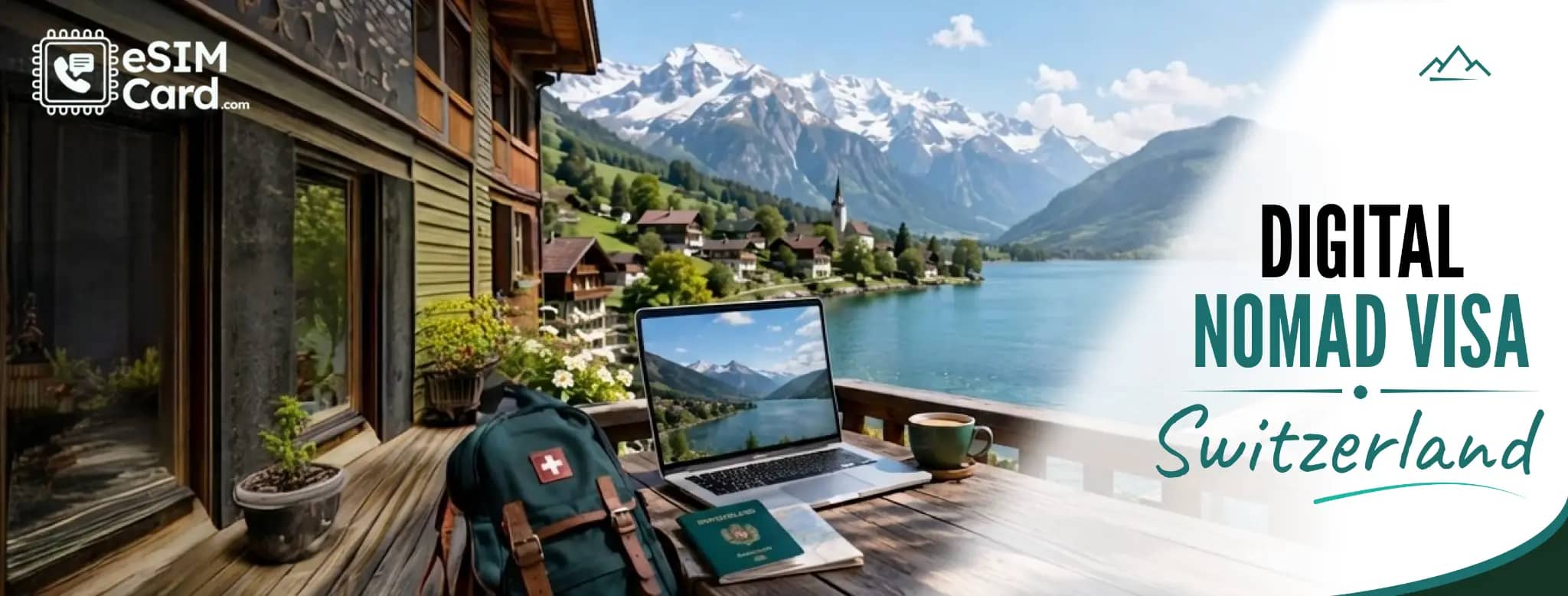
Switzerland Digital Nomad Visa: Requirements, Costs and Alternatives in 2026
Switzerland seems almost made for remote work. The trains run on time, internet access is reliable, the cities are safe, and a mountain escape is rarely far away.
Yet moving there as a digital nomad is much harder than spending a few weeks working beside Lake Geneva.
The reason is simple: Switzerland does not have a dedicated digital nomad visa. Remote employees, freelancers and online business owners must use the country’s existing immigration system.
The route available to you depends mainly on your nationality, the work you perform, how long you plan to stay and whether your presence serves a recognised economic or personal purpose.
EU and EFTA citizens have a relatively clear path under Switzerland’s freedom-of-movement arrangements.
Applicants from the United States, United Kingdom, Pakistan, India and other non-EU/EFTA countries face stricter labour-market rules and limited permit quotas.
This guide explains what those differences mean in practice. It covers legal remote work, L and B permits, self-employment, application documents, taxes, health insurance, living costs and easier European alternatives.
Important: Immigration and tax rules depend on your nationality, canton and personal circumstances. Confirm your case with the relevant Swiss authority or a qualified adviser before moving or applying.
4.9

Highly Rated
Based on 500,000+ customer reviews

Trusted worldwide
Over 1 million travelers across the globe have trusted us

Travel Friendly
No swaps, global connectivity ensured
Does Switzerland Have a Digital Nomad Visa?
No, Switzerland’s official residence and work-permit system does not include a separate immigration category for digital nomads.
You cannot apply simply because you work online, receive a foreign salary or have enough savings to support yourself.
Instead, you must qualify under Switzerland's existing work-permit system, such as employment, self-employment or another recognised residence route.
For most new remote workers, the relevant permits are:
- The L short-term residence permit
- The B residence permit
- A permit linked to approved Swiss employment
- A permit linked to an accepted business or self-employment case
- A residence arrangement for a financially independent person who will not work in Switzerland
The C permit is not an entry route for digital nomads. It is a settlement permit that normally becomes relevant after several years of lawful Swiss residence.
Switzerland’s State Secretariat for Migration states that settlement may generally follow five or ten years of residence, depending on nationality and the applicable rules.
Switzerland Digital Nomad Visa at a Glance
Can You Work Remotely From Switzerland Legally?
Remote work is not covered by one simple yes-or-no rule.
Your position depends on:
- Your citizenship
- Your current country of residence
- The length and purpose of your stay
- Whether you are employed or self-employed
- Where your employer and clients are based
- Whether your work is treated as gainful activity in Switzerland
- Whether a notification or permit is required
- Which social-security system applies
A foreign employment contract does not automatically give you the right to move to Switzerland.
Where the work is physically performed can also create immigration, tax, payroll and social-security consequences.
Rules for EU/EFTA Citizens
Citizens of EU and EFTA member states benefit from the Agreement on the Free Movement of Persons.
Switzerland's EU/EFTA rules provide easier access to employment and residence when the applicable conditions are met.
However, the work generally has to be reported through the official notification procedure.
For employment lasting longer than three months, the worker must register with the commune where they live and apply for a residence permit.
Registration must normally take place within 14 days of arrival and before work begins.
The permit issued depends largely on the employment contract:
- An L permit is generally used for contracts lasting from three months to less than one year.
- A B permit is generally used for contracts lasting at least one year or for an unlimited period.
- A B permit may also be issued to someone who proves genuine self-employment.
EU/EFTA access is easier, but that does not mean every remote arrangement is automatically accepted.
A person working from Switzerland for a foreign company may still need to address registration, social security, tax and employer obligations.
Rules for Non-EU/EFTA Citizens
The rules are much tighter for third-country nationals. Switzerland generally admits only a limited number of highly qualified managers, specialists and other skilled professionals from outside the EU/EFTA area.
The applicant usually needs higher education, relevant professional experience and skills that are valuable to the Swiss labour market.
For a normal employment route, the Swiss employer must apply for the permit.
The employer may also have to show that a suitable candidate could not be recruited from Switzerland or an EU/EFTA country.
Salary and working conditions must meet local and industry standards. This is why a remote employee cannot usually say, My company is abroad, so Swiss work-permit rules do not apply.
Working online for an overseas employer does not create an independent right of residence.
UK nationals are also generally treated as third-country nationals for new applications because the EU-Switzerland freedom-of-movement agreement no longer applies to them.
Working for a Foreign Employer
A foreign employer can create additional complications. For example, an employee physically working in Switzerland for an employer based in an EU or EFTA state may become subject to Swiss social-security rules.
In some cases, the foreign employer must register with Swiss insurance institutions and arrange employer and employee contributions.
Temporary postings and cross-border arrangements can be treated differently, especially where an international social-security agreement applies.
Before moving, both the employee and employer should check:
- Whether Swiss work authorisation is required
- Whether the employer must register locally
- Which country collects social-security contributions
- Whether an A1 certificate or similar document is needed
- Whether Swiss payroll or tax-withholding obligations arise
- Whether the move creates a permanent-establishment risk for the employer
Can You Work Remotely as a Tourist?
Do not treat a tourist stay as a remote-work permit. Many travellers may visit Switzerland and the wider Schengen Area for up to 90 days in any 180 days, depending on nationality.
That rule relates to entry and short stays. It does not provide unrestricted permission to relocate temporarily and carry out a normal job.
Switzerland’s short-term notification procedure applies only to particular categories. These include certain EU/EFTA workers, posted workers from qualifying EU/EFTA employers and EU/EFTA self-employed service providers. It does not cover everyone who arrives with a laptop.
Checking an occasional email while travelling is not the same as moving into an apartment and working full-time from Switzerland for several months.
Switzerland Visa and Permit Options for Remote Workers
The following table shows the routes most likely to appear during your research.
L Short-Term Residence Permit
The L permit is intended for limited stays. For an EU/EFTA worker, it is generally tied to an employment contract lasting from three months to less than one year.
Its validity normally follows the contract’s duration. Work lasting less than three months may fall under the notification procedure instead.
A third-country national may also receive an L permit after an approved employment or entrepreneur application.
However, these permits are limited and subject to the admission conditions that apply to non-EU/EFTA nationals.
An L permit is therefore not a general-purpose nomad permit. It must be linked to a recognised reason for residence.
B Residence Permit
The B permit is used for longer residence. EU/EFTA citizens may receive it when they have:
- An employment contract lasting at least one year
- An unlimited employment contract
- Genuine self-employment
- Sufficient financial resources and appropriate insurance when not working
A qualifying EU/EFTA B permit is generally valid for five years and can be renewed while the conditions continue to be met.
For third-country nationals, a B permit may follow an approved employment or entrepreneur application.
It is not automatically available to someone whose only connection to Switzerland is a remote job abroad.
Is the C Permit Available to Digital Nomads?
The C permit is not an initial digital nomad or remote-work route. It is a settlement permit for people who have already completed the required period of legal residence in Switzerland.
Depending on nationality and the applicable arrangement, the earliest settlement point may be after five or ten years.
New arrivals should focus on whether they qualify for an L or B permit rather than treating the C permit as part of the first application.
Switzerland Self-Employment Visa and Permit Route
Freelancers often assume that self-employment will make the process easier. That can be true for some EU/EFTA citizens. It is rarely true for applicants from third countries.
EU/EFTA Self-Employed Workers
EU/EFTA citizens can establish a self-employed activity in Switzerland. They must normally register with their local commune within 14 days and provide evidence that the business is genuine and financially viable.
The authorities may request documents such as:
- Client contracts
- Issued invoices
- Accounting records
- A business plan
- Commercial-register documents
- VAT registration
- Social-insurance registration
- Proof of available funds
The person must also be able to support themselves and any dependent family members. A business plan alone may not be enough.
The overall evidence should show that the applicant is already operating, or is genuinely ready to operate, a real business.
Non-EU/EFTA Entrepreneurs
A third-country national generally has no automatic right to move to Switzerland and become self-employed.
The applicant must make a convincing case that the business will have a lasting positive effect on the Swiss labour market. Swiss guidance gives examples such as:
- Creating or preserving jobs
- Making substantial investment
- Bringing new orders into the Swiss economy
- Diversifying the regional economy
- Developing meaningful commercial relationships
The application normally needs a detailed business plan, financial forecasts, investment evidence and company-formation documents.
If the case is accepted, the entrepreneur may receive an L or B permit. Both remain subject to annual quotas.
A freelancer with several overseas clients but no Swiss investment, hiring plan or local economic impact may struggle to meet this test.
Does Switzerland Have a Golden Visa?
Switzerland does not publish a standard federal immigration programme officially called the Golden Visa.
The phrase is commonly used by private advisers when discussing residence arrangements for wealthy foreign nationals.
Some cases involve expenditure-based taxation for eligible foreigners who move to Switzerland without carrying out gainful activity there.
There is no single nationwide price that guarantees a permit. The result depends on the applicant, the canton, the proposed tax arrangement, and immigration approval.
This is generally not a realistic route for an ordinary freelancer or remote employee. It is aimed at financially independent or high-net-worth applicants who can reside without working in Switzerland.
Switzerland Digital Nomad Visa Requirements
Because the visa itself does not exist, there is no universal checklist carrying that name. Your requirements will depend on the route you use, but authorities may ask for:
- A valid passport or identity document
- A qualifying employment contract
- Confirmation from an employer
- Proof of education and professional qualifications
- Employment references
- A detailed CV
- Evidence of sufficient funds
- Proof of accommodation
- Health and accident insurance
- A business plan
- Company-registration documents
- Client agreements and invoices
- Evidence of investment or job creation
- Criminal-record certificates
- Passport photographs
- Certified translations
- A national visa application, where required
Third-country employment cases may also require the employer to show that local and EU/EFTA recruitment options were considered before hiring from abroad.
Documents Required for a Swiss Residence Permit
Requirements vary by canton, but the following categories provide a practical starting point.
Documents for EU/EFTA Employees
An EU/EFTA employee may need:
- A valid passport or national identity card
- A Swiss residential address
- A signed employment contract
- Written confirmation of the job
- Details of contract duration and working hours
- Registration forms supplied by the commune
- Passport photographs
- Health and accident insurance details
Documents for Self-Employed Applicants
A freelancer or business owner may need:
- A business plan
- Client agreements
- Recent invoices
- Accounting records
- Bank statements
- Proof of business registration
- VAT or social-insurance registration
- Financial forecasts
- Proof of professional activity
- Evidence that the business can support the applicant
Additional Documents for Non-EU/EFTA Workers
A third-country applicant may also need:
- University degrees
- Professional certificates
- Employment references
- Proof of specialist experience
- A detailed CV
- Proposed salary and employment terms
- The employer’s recruitment evidence
- An explanation of the economic benefit to Switzerland
- Original documents or certified copies
- Translations into an accepted language
The canton may ask for additional evidence, so obtain the latest checklist before submitting anything.
How to Apply to Live and Work Remotely in Switzerland
There is no central digital nomad visa form. Applications follow the procedure for the permit category that applies to you.
Application Steps for EU/EFTA Citizens
1. Choose the correct work category
Work out whether you are taking Swiss employment, providing a temporary service, being posted by a foreign employer, or establishing a self-employed business.
2. Secure employment or prepare business evidence
Employees need written confirmation of employment. Self-employed applicants need proof that the business is genuine and able to support them.
3. Check whether notification is enough
Some qualifying work lasting up to three months or 90 working days may use the notification procedure instead of a residence permit.
4. Register with the local commune
For longer stays, register in the municipality where you will live. This generally has to happen within 14 days of arrival and before starting work.
5. Submit the permit application
Provide your identity document, employment confirmation or self-employment evidence and any other documents requested by the canton.
6. Arrange health insurance
People taking up residence usually need compulsory Swiss health insurance unless a recognised exemption applies.
Application Steps for Non-EU/EFTA Citizens
1. Find a qualifying route
This is usually highly skilled Swiss employment, an entrepreneur application, family residence or another recognised basis for admission.
2. Ask the Swiss employer to apply
For employment cases, the employer normally submits the work-permit application to the competent cantonal authority.
3. Prove that the admission conditions are met
The application may need to address qualifications, labour-market priority, salary, working conditions, quotas and Switzerland’s economic interest.
4. Wait for cantonal and federal approval
A job offer does not guarantee approval. The permit must still pass the required checks and remain available within the quota.
5. Apply for an entry visa where required
Some nationalities need a visa in addition to the work authorisation. Visa requirements depend on citizenship and the planned duration of stay.
6. Enter Switzerland and register locally
Third-country workers must generally register with the authority at their place of residence no later than 14 days after arrival and before beginning work.
Before departure, you can also install your eSIM early so mobile data is ready when you arrive in Switzerland.
Where Do You Submit the Application?
The canton where you plan to live or work normally handles the permit process. Depending on your route, the authorities involved may include:
- The local commune
- The cantonal migration office
- The cantonal labour-market authority
- The State Secretariat for Migration
- A Swiss embassy or consulate
Cantons issue residence permits and may use different forms, fees and processing procedures.
Switzerland Digital Nomad Visa and Living Costs
There is no fixed digital nomad visa fee because there is no such visa. Your actual moving costs may include:
- Visa fees where applicable
- Cantonal permit charges
- Commune registration
- Document translation and certification
- Criminal-record certificates
- Passport photographs
- Health insurance
- Rental deposits
- Business-registration expenses
- Immigration or tax advice
The official Swiss portal notes that permit costs vary, so the competent canton should be treated as the source for the final amount.
Permit and Application Costs
A short-stay Schengen visa currently costs EUR 90 for an adult, although exemptions apply and an external service provider may charge an additional service fee.
Fees for a national visa, residence permit and cantonal registration can differ. Do not treat the Schengen visa fee as the complete cost of moving to Switzerland.
A person staying longer than 90 days may need a national visa, residence authorisation and local registration.
Health Insurance Costs
Anyone settling in Switzerland generally has three months to obtain compulsory health insurance.
When insurance is arranged within that period, coverage normally begins from the start of residence.
The average compulsory health-insurance premium across age groups is CHF 393.30 per month in 2026.
The average adult premium is higher, at CHF 465.30 per month. Your actual price depends on your age, canton, insurer, deductible, and coverage model.
Basic insurance also includes cost sharing. The standard adult deductible is CHF 300 per year, followed by a 10% retention fee up to the annual limit set by law.
Monthly Living Costs
Switzerland is expensive even before taxes and insurance are considered. Recent crowd-sourced figures put a one-bedroom apartment outside the city centre at roughly:
These are approximate market figures rather than guaranteed prices. Central apartments, furnished rentals and short-term accommodation can cost considerably more.
You should also budget for groceries, transport, utilities, home internet, mobile data, coworking, eating out, taxes and leisure.
Suggested Monthly Budget
The following ranges are planning estimates, not official minimum-income requirements:
The required amount can rise quickly if you use temporary accommodation, eat out regularly, support dependants or choose a low health-insurance deductible.
Switzerland Tax Rules for Remote Workers
The familiar 183-day rule does not tell the whole story. Under Swiss domestic rules, tax residence may arise when someone stays in Switzerland:
- For at least 30 days while carrying out gainful activity
- For at least 90 days without carrying out gainful activity
A person may also become tax resident by establishing their home or centre of personal and economic life in Switzerland.
The 183-day test appears in many tax treaties, but it should not be treated as a universal promise that no Swiss tax applies before day 184.
Your final position may depend on:
- Where you physically work
- Where your permanent home is
- Where your family lives
- Your employer’s location
- Your country of previous residence
- The relevant double-taxation agreement
- The canton and commune where you settle
- Whether your employer creates Swiss payroll obligations
Switzerland levies taxes at federal, cantonal and municipal levels, so the total burden varies by location.
A remote worker planning to stay for several months should obtain cross-border tax advice before moving, not after receiving the first tax letter.
Health Insurance and Social Security
Health insurance and social security are separate matters.
Compulsory health insurance pays for covered healthcare. Social-security contributions fund areas such as old-age, survivors and disability insurance, unemployment cover and other statutory benefits.
People living or working in Switzerland are generally brought into the Swiss social-security system unless an international agreement or valid posting arrangement keeps them insured elsewhere.
A foreign employer may therefore face responsibilities even when it has no Swiss office. The correct treatment depends on the country involved, the employee’s nationality and whether the arrangement is permanent, temporary or split between several countries.
Ask the employer to review the arrangement before the move. Immigration approval does not automatically settle tax, payroll or social-security questions.
Best Swiss Cities for Remote Workers
Zurich
Zurich is the obvious choice for people who value professional networking.
It has a strong finance, technology and startup scene, excellent public transport and direct connections to many European cities.
The trade-off is housing. Finding a suitable apartment can take time, and both central and suburban rents are high.
Geneva
Geneva suits people working in international development, finance, consulting or multinational organisations.
French is the main local language, while English is common in international workplaces.
The city is well connected and sits beside the lake, but its rental market is among Switzerland’s most expensive.
Basel
Basel offers a more relaxed alternative without feeling cut off. It is especially attractive to people working in pharmaceuticals, healthcare, science and life sciences.
France and Germany are both close enough for day trips, and rents can be lower than in Zurich or Geneva.
Bern
Bern feels calmer than Switzerland’s main commercial centres. It works well for remote professionals who value walkability, reliable transport and a slower pace.
Housing can be more manageable than in Zurich or Geneva, although it is still expensive by wider European standards.
Zug
Zug attracts founders, investors and international companies because of its business environment and tax reputation.
That reputation does not create an immigration shortcut. You still need a valid residence and work route, and local housing can be costly.
If you're still deciding when to relocate or spend an extended period in the country, check the best time to visit for seasonal weather, crowds and activities.
How to Stay Connected in Switzerland With an eSIM
Internet access is one of the easier parts of arriving in Switzerland.
A travel eSIM can provide mobile data while you look for accommodation, wait for home broadband, or travel between cities.
It also lets you keep your regular SIM active for banking messages, verification codes, and calls from home.
eSIMCard offers prepaid Switzerland eSIM packages ranging from 1 GB to unlimited-data options.
Its current Switzerland listings show plans starting at $2.10, with access to Sunrise and Salt networks and hotspot support on listed packages.
Prices, speeds and availability can change, so check the live product page before buying. Installation is handled digitally through a QR code or manual activation.
Your phone must support eSIM and should be carrier-unlocked. Travellers visiting Switzerland alongside France, Germany, Italy or Austria may find a Europe eSIM more convenient than buying a separate plan at each border.
An eSIM solves connectivity. It does not change your immigration, employment or tax status.
How to Check Whether Your Phone Supports eSIM
On an iPhone, open the mobile settings and look for Add eSIM or Add Cellular Plan.
On Android, look for options such as:
- SIM Manager
- Add eSIM
- Download SIM
- Add Mobile Plan
The wording varies by manufacturer. You can also check our compatible phones list before purchasing a plan.
Who Is Switzerland Not Suitable for as a Digital Nomad?
Switzerland may not be the right base for:
- A non-EU freelancer with no meaningful Swiss business connection
- A remote employee whose company cannot support local compliance
- Someone planning to work under tourist status
- A founder without investment, job creation or a credible business plan
- A traveller looking for a low-cost European destination
- A person without enough savings for rent, insurance and deposits
The country becomes more realistic when you have EU/EFTA rights, qualifying Swiss employment, specialist experience, family residence rights or a serious business case.
Alternatives to the Switzerland Digital Nomad Visa
Remote workers who cannot qualify in Switzerland may find a clearer route elsewhere in Europe.
Spain’s international telework visa is intended for qualifying non-EU nationals who work remotely for companies outside Spain.
Self-employed applicants may perform a limited share of their work for Spanish clients. Portugal's D8 visa provides a residence route for qualifying remote workers earning income from employers or clients outside Portugal.
The temporary residence authorisation is currently valid for two years and may be renewed for successive three-year periods, subject to the rules in force.
Both countries offer a more recognisable immigration category for a conventional remote employee or freelancer.
Switzerland may still be the better choice for someone with EU/EFTA rights, a Swiss job or a strong local business plan.
Conclusion
Switzerland is an excellent place to work remotely once you have a legal right to live and work there. Getting that right is the difficult part.
There is no dedicated Switzerland digital nomad visa in 2026. EU/EFTA citizens can often use the country’s freedom-of-movement framework.
The non-EU/EFTA applicants usually need approved Swiss employment, an economically valuable business, or another recognised basis for residence.
Do not rely on foreign income, tourist entry or a loosely defined “Golden Visa” arrangement. Start by identifying the permit category that actually fits your nationality and work.
Before moving, check immigration, taxes, health insurance, social security, employer compliance and accommodation costs.
Once those pieces are in place, practical matters such as banking, public transport and mobile internet become much easier.
A Switzerland eSIM from eSIMCard can keep you connected when you arrive, but it belongs on your travel checklist, not in your immigration strategy.
FAQs
Does Switzerland have a digital nomad visa in 2026?
No, Switzerland does not offer a dedicated digital nomad visa. Remote workers must qualify through an existing Swiss work, residence, or self-employment permit.
Can I legally work remotely from Switzerland?
Yes, but only when your immigration and work status permits it. A tourist stay or foreign employment contract does not automatically authorise remote work in Switzerland.
Can I work remotely in Switzerland for 90 days?
The 90-day Schengen rule allows short visits, not unrestricted remote work. You may need prior authorisation or notification depending on your nationality, employer and work activity.
Which Swiss permit can a remote worker apply for?
An L permit may cover short-term qualifying work, while a B permit may cover longer employment or approved self-employment. Switzerland has no permit created specifically for digital nomads.
Can a freelancer move to Switzerland?
EU/EFTA freelancers may qualify by proving genuine self-employment and sufficient income. Non-EU/EFTA freelancers usually need to show that their business will benefit the Swiss economy.
How much does it cost to apply as a remote worker in Switzerland?
There is no fixed digital nomad visa fee because the visa does not exist. Costs vary by canton and may include permit fees, registration, insurance, translations and document certification.
Do digital nomads need health insurance in Switzerland?
Yes, people who become Swiss residents generally need compulsory health insurance within three months. Exceptions may apply to certain posted workers and people covered by international agreements.
Do remote workers pay tax in Switzerland?
Remote workers may become Swiss tax residents after 30 days of gainful activity or 90 days without gainful activity. Tax treaties and personal circumstances can change where income is ultimately taxed.