Emma Sky
29 Jul 2026
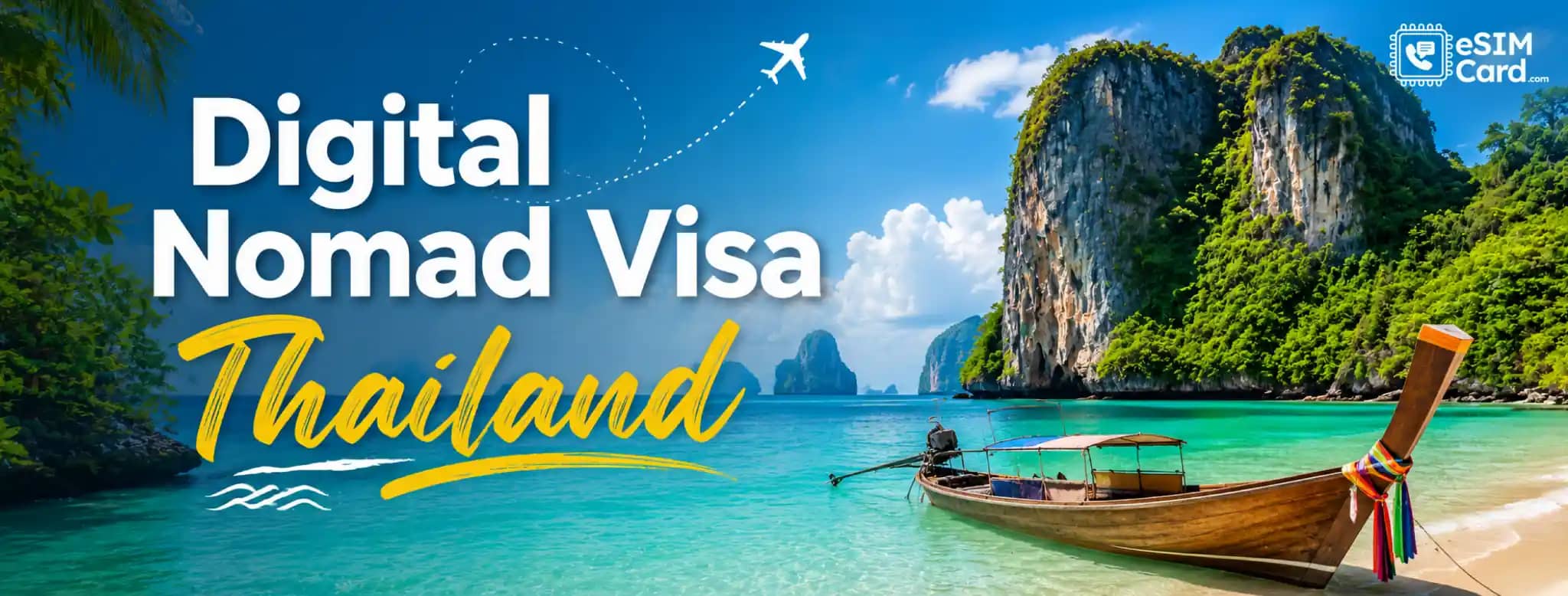
Thailand Digital Nomad Visa 2026: DTV Requirements, Cost & How to Apply
If you are looking for a Digital nomad visa for Thailand, type Thailand digital nomad visa into Google. You will find three visas fighting over that label. Only one was actually built for remote workers, and it has a real name: the Destination Thailand Visa, or DTV.
In this guide, when I say digital nomad visa, I mean the DTV. That distinction matters because most of the confusion floating around online comes from people blending the DTV with two completely different visas, the LTR (Long-Term Resident) visa and the Thailand Elite Visa.
The Thailand DTV is a five-year, multiple-entry visa, issued through Thailand's official eVisa system under the Ministry of Foreign Affairs, or through a Royal Thai Embassy or Consulate.
The best cities for digital nomads are Bangkok, Chiang Mai, Phuket, Koh Samui, and Pattaya. A quick honesty check before we get into it:
Thai immigration rules shift more often than people expect, and different embassies sometimes ask for slightly different paperwork.
In this guide, we will explain what you need to know about Thailand Visa, Digital nomad visa, how you can apply, costs, and the requirements.
4.9

Highly Rated
Based on 500,000+ customer reviews

Trusted worldwide
Over 1 million travelers across the globe have trusted us

Travel Friendly
No swaps, global connectivity ensured
What Is Thailand's Digital Nomad Visa (Destination Thailand Visa)?
Thailand's digital nomad visa is known as the remote work visa. It is a legal permit that allows you to work remotely for an employer or client based outside of that country.
The key characteristics of this visa are location independence, no local employment, and temporary residence. The requirements for a digital nomad visa are simple.
You just need a valid passport, a clean criminal record, proof of remote work employment, and proof of income. You can also apply for a digital nomad visa as a tourist.
Destination Thailand Visa (DTV) Quick Facts
The Thailand DTV is a long-term visa launched in July 2024 through the Ministry of Foreign Affairs. It allows remote workers, freelancers, and individuals to work as professionals. Officially, it is filed under a tourist visa, which sounds a little unimpressive for something that
lets you live and work in Thailand for years at a time. You can choose the visa according to your needs and preferences.
There are two pathways to the DTV:
- Workcation. Built for remote employees, freelance contractors, and business owners whose paychecks come from somewhere outside Thailand.
- Soft Power. For people coming to take part in an approved cultural or wellness program, such as Muay Thai training, a Thai cooking course, medical treatment, or a seminar, rather than working remotely at all. Each pathway requires different supporting documents to get there.
Thailand DTV Eligibility Requirements (2026)
Three things decide whether you get this visa: your money, your reason for going, and your paperwork.
On the money side: You need 500,000 THB, or the equivalent in the currency your account holds, sitting in savings. Not stocks. Not crypto. Just cash, and it needs to have been there a while, not deposited last week.
A single payment before you apply tends to look like a loan someone gave you, not proof you can support yourself. How long exactly it needs to sit varies a bit by embassy, so check with your specific consulate before you assume anything.
Workcation:
- An employment contract, Freelance client agreements, or business registration papers that show your money comes from outside Thailand
- Something proving your employer or clients are real, since a handful of embassies dig into this more than you'd expect
- Recent invoices or pay stubs as backup
Soft Power:
- Confirmation that you are enrolled somewhere approved, a Muay Thai gym, a cooking school, a sports program, a medical facility, that kind of thing
- A program that runs for a real stretch of time, not two weeks. Short courses get turned down far more often, so the longer and more verifiable your enrollment, the better your odds
Everyone applying needs:
- A passport with at least 6 months left on it, plus a passport-style photo
- Bank statements backing up that 500,000 THB
- Proof of address or a travel itinerary, depending on where you're applying
- To actually be outside Thailand when you apply. You can't walk into an immigration office in Bangkok and start this process while you're already in the country.
- A clean record with Thai immigration, no overstays, no blacklisting.
How Much Does the DTV Actually Cost?
Here's a realistic breakdown of the costs for the DTV. You can understand from the comparison table and estimate your cost for a visa.
That table does not include the 500,000 THB sitting in your savings. It is not a fee, just proof of funds.
Add up the application, one extension, and decent insurance, and a realistic first-year number is closer to $600 to $1,000, not the $275 you see quoted everywhere.
DTV vs LTR vs Thailand Elite Visa vs Non-B Work Permit
Always choose the right path depending on your financial and professional status. You can take the idea from here, understand the features, and decide on your visa type.
There are other Thai visas too, worth a passing mention even if none of them fit a remote worker: a Tourist Visa and a Visa Exemption for short trips.
A Visa on arrival for eligible passport holders, an Education Visa (ED) for students. Retirement Visa (O to A) for people over 50, and a Marriage Visa for spouses of Thai citizens.
If you are freelancing or working remotely for a company back home, the Thailand DTV is almost certainly what you want.
If you're also considering Europe, our Portugal Digital Nomad Visa guide explains the eligibility requirements, application process, and costs. Spain is another popular choice for remote workers, and our Spain Digital Nomad Visa guide compares its requirements with other digital nomad destinations.
The LTR only starts making sense once you are clearing six figures a year. If you are thinking of the Elite Visa as a lifestyle purchase more than a work visa.
It skips the income proof but does not let you work either. And the Non-B is a different conversation entirely; that's for people actually taking a job with a Thai employer.
How to Apply for the DTV Step by Step?
- Confirm which category fits you, Workcation or Soft Power, and pull together the documents that go with it: passport, bank statements, employment contract or client invoices, proof of address.
- Get your savings in order. Move 500,000 THB into an account and leave it alone for as long as your embassy expects before you apply.
- Apply through the official Thailand eVisa portal or your nearest embassy or consulate. Remember, this has to happen from outside Thailand.
- Upload everything and pay the fee.
- Wait it out. Processing times swing from a few days to a few weeks depending on the embassy.
- Fill out the Thailand Digital Arrival Card, or TDAC, within 72 hours of your flight. Nearly everyone entering Thailand needs this now, not just DTV holders.
- Land, get through immigration, and walk away with your 180 day stamp.
- Get your address registered. If you're renting, your landlord is the one who's supposed to file a TM30, which just notifies immigration that a foreign national is staying there, within 24 hours of you showing up.
- If you are sticking around past 90 days, file the 90 days report. This ties into the TM47 form, which is the standard paperwork used for it.
- Think ahead about re-entry. Since one entry only stretches to about 360 days even with the extension, longer stays usually mean a quick trip out of the country and back in, what a lot of expats call a border run, rather than any kind of renewal.
The two things that trip people up most are trying to apply from inside Thailand, which is basically an automatic rejection, and forgetting the TDAC before you fly.
Who Should Apply for the Thailand digital nomad permit?
You can apply for a Thailand digital nomad visa if you are in one of these categories.
- Remote employees
- Freelancers
- Consultants
- Designers
- Developers
- Writers
- Online business owners
Why Do Thailand Digital Nomad Applications Get Rejected?
Rejections have picked up as embassies started checking documents more carefully than they did right after the visa was launched in 2024. The patterns keep repeating:
- Money that has not sat long enough. A balance that spiked right before you applied reads like a loan, not real savings.
- Thin proof of remote work. Vague invoices, or an employer nobody can easily verify.
- Soft Power programs that are too short. A one week course raises an eyebrow about whether it's genuine, and shorter enrollments do seem to get turned down more, though nobody publishes exact numbers on this.
- Applying while still in Thailand. Just do not.
- Fuzzy proof of where you actually are, which trips up people applying through a neighboring country's embassy instead of their own.
Get rejected, and most embassies will actually tell you why. Fix the specific problem, wait out the gap they want, and try again. It is not a permanent black mark.
Do You Pay Tax in Thailand on a Digital Nomad Visa?
Depends how long you stay, basically. Under 180 days in Thailand in a calendar year, and you are not a Thai tax resident. Go past that, and you become one, which means Thailand can tax any foreign income you bring into the country.
This rule got stricter in 2024, so if you are reading an older explanation somewhere, take it with a grain of salt. Cross into tax residency, and you may need a Thai Tax Identification Number to file locally.
Thailand also has double tax treaties with a lot of countries, which can stop you from getting taxed twice on the same income. None of this cancels out what you owe back home, either.
Americans still owe US tax on worldwide income, no matter where they've moved, though the Foreign Earned Income Exclusion knocks out a big chunk of that for people who qualify.
Every country handles this differently, so honestly, a real conversation with a tax professional is worth more than anything written here, including this.
Living in Thailand on a DTV Visa
Getting approved is one hurdle. Actually living there is a different thing entirely, and it helps to know what you are walking into.
Bangkok, Chiang Mai, and Phuket are where most people land first, each with its own coworking scene going.
Chiang Mai, in particular, has spent over a decade building a reputation as a nomad town, arguably before the term " digital nomad was even a common phrase.
Pattaya, Koh Samui, Koh Phangan, and Hua Hin pull a smaller crowd, usually people who'd rather trade city conveniences for beach access.
Housing tends to follow a pattern: Airbnb for the first few weeks while you scope out neighborhoods, then a longer lease once you've picked one.
Condos dominate in Bangkok and Phuket, while Chiang Mai leans more toward houses and smaller apartments. Having a lease in your name also helps with the address registration that your landlord handles through the TM30 filing.
On the money side, a lot of people run on Wise or Revolut at first, then open an actual Thai bank account once they've got a lease and a visa in hand.
It simplifies daily spending in ways currency conversion never quite does. And the community piece is real.
Bangkok and Chiang Mai both have thick networks of coworking spaces and long-running meetups, which take a lot of the edge off moving somewhere without knowing a soul.
Internet & Mobile Data for Digital Nomads in Thailand: eSIM vs SIM vs Pocket WiFi
The visa gets you into the country. This is what gets you online once you are standing in it. You can check all the available options for the internet in Thailand and pick one of them.
If you're new to the technology, learn what is an eSIM before your trip.
How to check if your device is eSIM compatible or not?
There are a few reliable ways to check, depending on your device:
Universal check
- Dial the code*#06# on any phone
- If it shows both an IMEI and an EID, eSIM is supported.
- No EID means no eSIM.
- Check the model number against the manufacturer's own compatibility list.
iPhone
- First of all, open the Settings General.
- Go to About and scroll down.
- If you see Digital SIM or an EID number, your phone supports eSIM.
- Alternatively, go to Settings.
- Click the Cellular or Mobile Data. If there's an option to Add eSIM or Convert to eSIM, it's supported.
- Dial *#06#, if an EID number shows up alongside your IMEI, eSIM is supported.
Android
- Go to the Settings App.
- Search Network & Internet
- SIMs path varies slightly by brand, Samsung, Pixel, etc.
- Look for an option like Add eSIM, Download a SIM instead, or Add using QR code.
- If that option does not exist at all, the device likely does not support eSIM.
Carrier Lock
You can check if your phone is eSIM compatible, but it must also be unlocked by your carrier to use an eSIM from a different provider. If you're using an Android device, you can check if your Android phone is unlocked before purchasing an eSIM.
Conclusion
If you are reading this guide because you work remotely and want to live in Thailand for a while, the DTV is almost certainly your visa, not the LTR, not the Elite Visa.
It runs on savings instead of income, which opens the door to a lot more people than the headline numbers suggest.
The process is doable if you follow the order above, and the mistakes that sink applications, unseasoned funds, applying from inside Thailand, and skipping the TDAC, are all things you can just avoid now that you know about them.
An eSIM means you can clear immigration, grab a coffee, and answer that first message from a client or your boss without hunting down a SIM counter first. Everything else about settling in can wait until tomorrow.
FAQs
What is Thailand's digital nomad visa called?
Thailand’s digital nomad visa is called the Destination Thailand Visa or DTV. This visa allows remote workers to stay for five years in the country.
How much does the Thailand digital nomad visa application cost?
The application fee for DTV is 10,000 THB, which is round about $275 to $500. It depends on the embassy.
How long can I stay in Thailand on a digital nomad visa?
You can stay up to 180 days per entry, extendable once for another 180 days at a local immigration office, about 360 days before you have to leave and come back. The visa itself runs 5 years, and you can re-enter as many times as you need during that window.
Is the DTV a multiple entry in Thailand?
Yes, you can leave and return repeatedly over the full 5 years, and each entry gives you a fresh stay period.
Can I leave Thailand and come back on the DTV?
Yes, it is actually part of the plan. You can leave and come back to Thailand, each time you enter automatically receive a fresh 18o days stamp on your passport.
Can I renew the Thailand remote work visa once it expires?
No, you cannot renew the Destination Thailand Visa. The validity of the visa is up to 5 years; once it expires, you leave the country. You will need to submit the new visa application for a different type of visa.
Can I switch from a tourist visa to the DTV while I'm in Thailand?
No, DTV applications need to be filed from outside Thailand. You must leave the country and apply for a DTV visa.
Can I apply for the DTV from Laos or Malaysia?
Yes, you can apply for a DTV visa from Laos or Malaysia.
Can I work for a Thai company on the DTV?
No, you cannot work for a Thai company on a digital nomad visa. It only covers remote work for employers or clients based outside Thailand. Working locally means a different visa, a Non-Immigrant B with a work permit.
Can I open a bank account with a DTV?
Opening a bank account with a Destination Thailand visa is a very difficult process. Banks technically classify the DTV as a tourist visa and usually require a work permit. Some applicants succeed by approaching specific bank headquarters or hiring legal agencies.
Can I study in Thailand on a Destination Thailand Visa?
Yes, you can study in Thailand on DTV. If study is your actual goal, an Education Visa (ED) fits better.
Can I bring my family on a Thailand digital nomad visa?
Yes, spouses and kids under 20 can come as dependents, each with a separate application backed by a marriage or birth certificate.
What's the difference between the DTV and the LTR visa?
The DTV runs on savings, 500,000 THB, and fits most remote workers and freelancers. The LTR wants a much higher income, around $80,000 a year for two years.
Do I need health insurance for the DTV?
No, you do not need health insurance for a Thailand digital visa because it is not a mandatory part of the visa.