
Lucas Frost
Updated : 24 Oct 2026
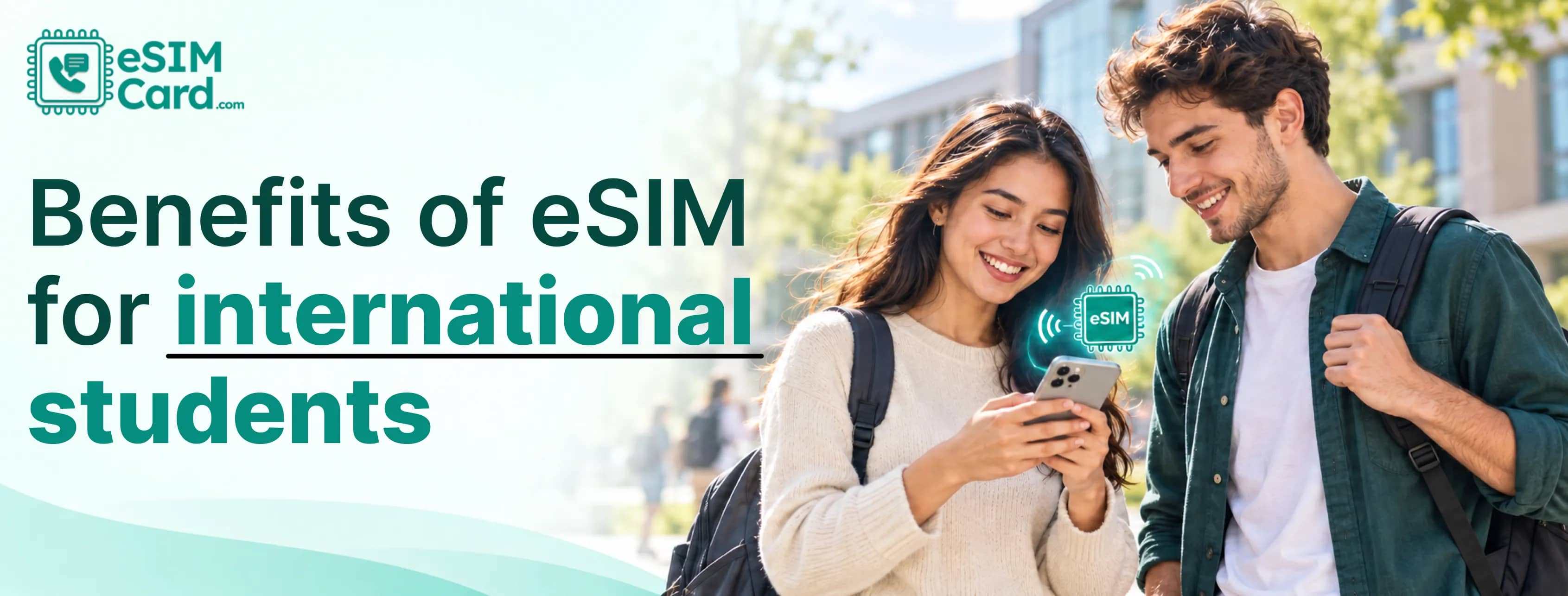
Benefits of eSIM for International Students in 2026
Your first hour in a new country can get hectic. You need Google Maps, a train ticket, your university email and a way to tell your family you have landed. Then you discover the airport SIM shop is closed.
An eSIM can solve that problem before it starts. You can often install a mobile data plan before departure and connect as soon as you arrive, without removing your home SIM card.
For international students, that is only part of the appeal. An eSIM can help control roaming costs, keep your existing number available and provide internet for university apps, online classes and weekend trips.
But it is not always the cheapest option for an entire degree. Some plans do not include calls, SMS or a local phone number. Knowing these limits can save you money and headaches later.
In this article, you will learn abouthow eSIMCard save students money on roaming, keep home SIM numbers active, and simplify student travell.
4.9

Highly Rated
Based on 500,000+ customer reviews

Trusted worldwide
Over 1 million travelers across the globe have trusted us

Travel Friendly
No swaps, global connectivity ensured
What Are the Benefits of eSIM for International Students?
Before exploring the benefits, understanding what is an eSIM and how it works can help international students choose the right mobile connectivity option.
An eSIM is a digital SIM profile that lets a compatible phone connect to a mobile network without inserting a physical SIM card. You can download the profile remotely, usually through a QR code or an app.
Here are the main benefits for students studying abroad.
These benefits depend on your phone, carrier and chosen plan. An eSIM provides the technology, but the provider determines many practical details.
1. Get Mobile Data as Soon as You Arrive
Landing somewhere unfamiliar is stressful enough. You should not have to search for a SIM shop before finding your accommodation.
With a compatible, unlocked phone, you can often buy and install an eSIM before leaving home. Once you reach your destination and the plan's activation conditions are met, mobile data can be available straight away.
That means you can check your airport transfer, message your landlord, open your university's welcome email or find the correct train platform.
For students heading to the United States, a prepaid United States eSIM from eSIMCard may be useful during arrival and orientation week.
You do not need to commit to a year-long phone contract just to get through your first few days. Get online, settle in and compare longer-term options once you are comfortable.
2. Keep Your Home SIM and Number Active
Changing countries does not mean you have to abandon your existing mobile number.
There are many compatible phones support Dual SIM, allowing you to keep your home SIM installed while using an eSIM for foreign mobile data. Some devices support two active eSIMs, while others use a physical SIM alongside an eSIM.
That arrangement can be handy when your home bank sends a one-time password (OTP) by text. You may also want to retain your existing number for WhatsApp, family calls or account recovery.
Check your home carrier's rules before departure. Keeping the home SIM active can still trigger roaming charges, especially if you answer calls, send texts or allow it to use mobile data.
Also, receiving verification messages depends on your home carrier, account and destination network. Do not assume every bank text will arrive automatically.
According to Apple's Dual SIM guide, compatible iPhones allow users to keep their primary number active while using a separate travel eSIM for mobile data.
3. Reduce Expensive International Roaming
International roaming can become expensive when your home carrier charges separate rates for data abroad. A few days of navigation, social media and video calls can cost more than expected.
A prepaid travel eSIM gives you another option. You pay for a stated allowance or package rather than relying entirely on your home carrier's roaming rates.
For example, a student arriving in the US might choose a short-term data plan for airport transfers, orientation and the first month. Once settled, they can compare local student tariffs and prepaid plans.
An eSIM is not automatically cheaper than every physical SIM or local plan. The savings depend on your destination, data usage, package validity and available offers.
Before buying, compare the total cost rather than the headline price. Check how much data you get, whether speeds are restricted, how long the package lasts and what happens when your allowance runs out.
Your home carrier may also offer an affordable international roaming package. Compare that price with travel eSIMs and local plans before deciding.
4. Change Plans Without Swapping SIM Cards
An eSIM makes adding a supported mobile plan easier because you do not need to insert a new plastic card.
That flexibility suits students whose plans change during the academic year. You might start with a data-only plan, switch to a local carrier after finding accommodation or add another plan for a semester break.
Each plan has different detail, you need to check the description carefully then buy the plans according to your needs:
- Local eSIM: Designed for one country, such as the US or Germany.
- Regional eSIM: Covers multiple countries within a region, subject to the package's country list.
- Global eSIM: Offers coverage across selected countries worldwide, depending on the plan.
Check the coverage list before travelling. A European regional plan, for example, may not cover every European country or include the same allowances everywhere.
Moving an existing eSIM to a new phone is a separate matter. Transfer support depends on the device, operating system, carrier and provider. You may need a new QR code or help from customer support.
5. Use a Hotspot for Your Laptop or Tablet
Your phone might have enough data for messages and maps. Your laptop is another story.
University accommodation does not always have working Wi-Fi on arrival day. Broadband installation can take time, and campus networks sometimes fail during a deadline week.
If your eSIM plan supports tethering, you can share its mobile connection with a laptop or tablet. That can keep you connected to Canvas, Moodle, Blackboard, Zoom, Microsoft Teams and university email when Wi-Fi is not available.
Before relying on this setup, you should check the provider's hotspot policy. Some plans restrict tethering or apply different limits to shared data.
Watch your usage, too. A laptop can download operating system updates, sync cloud files and stream lectures in the background. Those tasks can consume a mobile allowance surprisingly quickly.
If you are going to take online classes, use campus or residence Wi-Fi whenever possible. Keep your eSIM as a backup unless you have purchased enough data for frequent hotspot use.
6. Stay Connected During Weekend and Semester Travel
Studying abroad often means more than staying in one city. Exchange students might study in Germany and visit France or Italy during weekends. Students based in Singapore might explore neighbouring countries during semester breaks.
A suitable regional eSIM can cover multiple destinations without requiring a separate physical SIM in each country.
Coverage still matters. A plan that works in Germany might not include Switzerland, and a North American package might treat Canada and Mexico differently from the United States.
Before buying a regional or global plan, check its supported countries, data allowance, validity period and network restrictions.
If you travel frequently, compare the cost of separate local plans against a regional package. For occasional trips, a short-term eSIM may be all you need.
eSIMCard offers travel connectivity options for students who want to compare destination-specific and multi-country coverage.
7. Avoid Losing or Damaging a Physical SIM
Small SIM cards are easy to misplace. You might remove your home SIM at the airport, put it somewhere safe and forget where you left it.
An eSIM avoids that particular hassle because its profile is stored digitally on a compatible device. You do not need to remove your physical SIM just to add a supported travel plan.
There is a security benefit, but it has limits. An eSIM cannot be pulled from the phone's SIM tray if you are using only a digital profile. It does not make a stolen phone theft-proof or protect every account from fraud.
The GSMA explains that consumer eSIM provides security and protection equivalent to removable SIM technology. It is not a VPN, and it does not automatically hide your IP address or prevent phishing attacks.
You should use a strong screen lock password, enable account recovery protections and keep your phone's software updated. Contact your carrier promptly if your device goes missing.
If you're deciding between traditional SIM cards and digital alternatives, comparing eSIM vs physical SIM can help you understand their differences in convenience, flexibility, and security.
eSIM vs Local SIM vs Home Roaming for Students
Which option makes the most sense? It depends on how long you're staying and what you need your phone to do.
A travel eSIM is often the easiest way to get connected quickly. A local carrier can make more sense once you need a permanent local number, a large monthly data allowance or a student discount.
Home-carrier roaming is convenient because your existing service may work immediately. But check the charges before using it as your main connection for several months.
How Much Data Does an International Student Need?
There is no single data allowance that suits every student. Your usage depends on how often you have Wi-Fi and whether you connect other devices.
Students who spend most of their time on campus Wi-Fi may need only a modest mobile allowance. Someone living in temporary accommodation or attending lectures through a phone hotspot may need considerably more.
Track your usage during the first week. Check your phone's data statistics and the provider's usage dashboard, then adjust your next package accordingly.
Also check whether a plan advertises unlimited data with a fair-use policy or speed restrictions. Unlimited does not always mean unrestricted high-speed data.
Before choosing a student data plan, estimate how much data you need for travel based on your online classes, video calls, social media, and daily browsing habits.
When Is a Local Mobile Plan Better Than a Travel eSIM?
For a two-week exchange visit, a travel eSIM may be all you need. For a three-year degree, the calculation can change.
A local plan is worth considering if you need a local number, make frequent calls, use substantial mobile data or qualify for student pricing. Some carriers also offer family packages or monthly allowances that suit long-term residents.
A travel eSIM may remain useful for arrival, temporary accommodation, backup internet and trips to neighbouring countries.
Here is a sensible approach: use a short-term plan when you land, settle into your accommodation and learn your university's connectivity options. Then compare local prepaid and monthly plans before committing to the rest of the semester.
Do not pay for flexibility you would not use. But do not sign a long contract before checking whether a prepaid option fits your needs better.
How to Prepare Your eSIM Before Studying Abroad
A little preparation at home can save a frustrating airport search.
- Check compatibility. Confirm that your phone supports eSIM and appears on your provider's compatibility list. See eSIMCard's eSIM-compatible devices resource.
- Check the carrier lock. A phone can support eSIM but still reject plans from other carriers if it is locked.
- Choose the right package. Compare destination coverage, data allowance, validity, hotspot support and voice or SMS features.
- Install before departure if permitted. Use reliable Wi-Fi and follow the provider's instructions. Keep the QR code or installation details accessible until setup is complete.
- Check activation timing. Some plans start when installed, while others activate when they connect to a supported network or use data. Read the terms before installation.
- Label your lines. Name them Home and Travel so you can identify the right line for calls, texts and mobile data.
- Review roaming settings. Set the intended data line and check your home SIM's roaming options to avoid unwanted charges.
If you're new to eSIM technology, follow our guide on how to get an eSIM to learn how to purchase and set up your mobile data plan before departure.
Internet in your pocket, before the plane door opens
Activate your plan on landing day and use maps, rides, and messages from the first minute.

Conclusion
Your best option may change as the semester unfolds. You might need a travel eSIM for the airport, a local number for banking and housing, then a regional package for weekend trips.
Think about your first week, not just your first day. Choose a plan that gets you online without forcing you into a long commitment before you understand local prices and requirements.
Compare eSIMCard's United States eSIM plans if you are heading to the US, or check a suitable regional option for multi-country study. Read the coverage, activation and calling details carefully.
FAQs
Is eSIM good for international students?
Yes, an eSIM can be useful if you need mobile data immediately, want to keep your home SIM or travel between countries. Compare local plans for longer stays.
Is an eSIM cheaper than international roaming?
It often can be, especially when your home carrier charges high roaming rates. Compare data allowances, validity and total costs before choosing.
Can I keep my home SIM while using an eSIM abroad?
Yes, many Dual SIM phones support both lines. You can often keep your home number active while using the eSIM for data, although roaming charges may still apply.
Can a travel eSIM receive bank verification texts?
A data-only travel eSIM usually cannot receive conventional SMS. Your home SIM may receive verification texts if your carrier and destination network support them.
Does an eSIM give international students a local phone number?
Not necessarily. Many travel eSIMs provide data only, so choose a plan with voice and SMS or a local carrier if you need a number.
Can I use WhatsApp with an eSIM?
Yes, WhatsApp works over mobile data. You can generally keep your existing account and number while using an eSIM for internet access.
Can I use an eSIM for an entire semester abroad?
Yes, if suitable plans cover your destination and study period. However, a local monthly plan may cost less or offer better calling options.
Can I hotspot my laptop using a student eSIM?
Yes, if your plan and network allow tethering. Check the hotspot rules and monitor data use during video classes and large downloads.
Do I need an unlocked phone to use a travel eSIM?
Yes. An eSIM-compatible phone that is locked to another carrier may reject a travel provider's profile.
Is eSIM safer than a physical SIM?
An eSIM removes the need to handle a removable card, and its provisioning uses standardized security measures. It does not prevent every form of theft, phishing or account compromise.