
Lucas Frost
10 Aug 2026
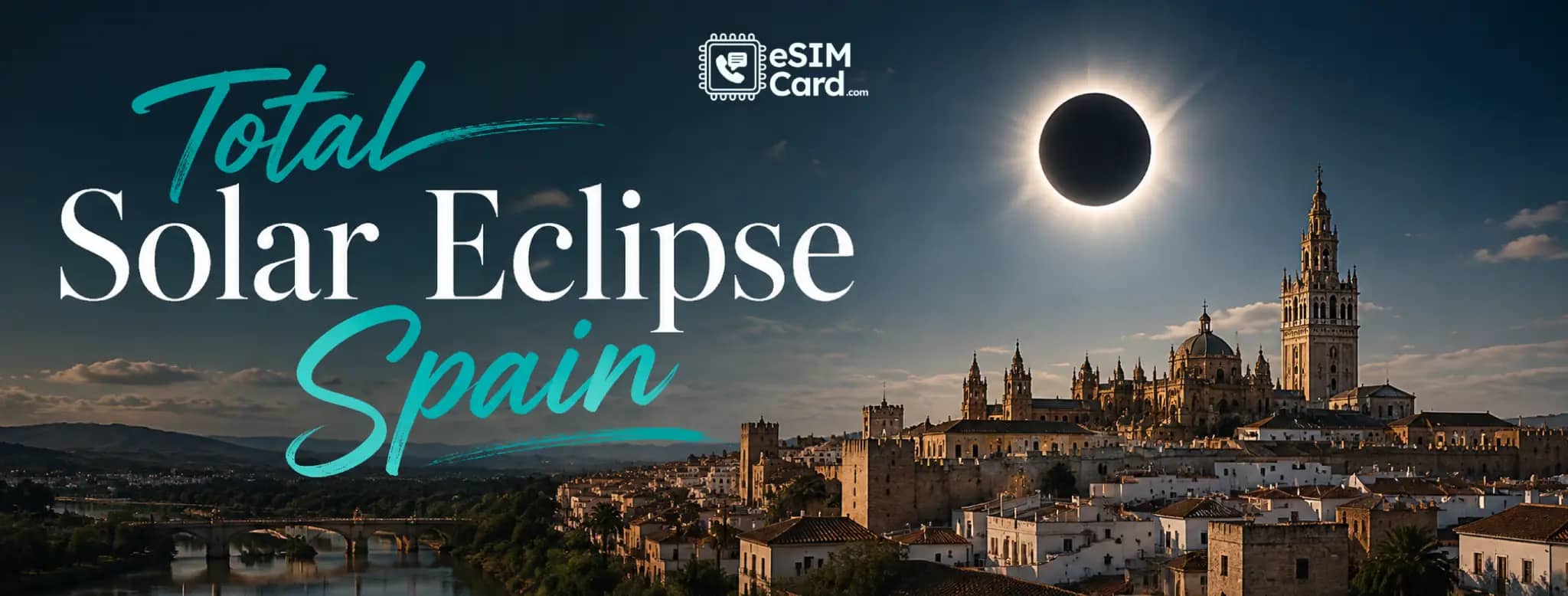
Total Solar Eclipse Spain 2026: Times, Map, Best Places and Travel Guide
You can stand inside the path of totality and still miss the eclipse. That is the awkward part of the Total Solar Eclipse Spain 2026.
The total solar eclipse will cross parts of northern and eastern Spain on 12 August 2026. Totality will occur near sunset, generally between 20:28 and 20:32 CEST, depending on the location.
Inland Castile and León and the Ebro Valley are strong planning bases, but the best final location will depend on short-range weather forecasts.
On 12 August 2026, the Sun will sit low in Spain’s western sky. A ridge or building could hide the moment you travelled to see.
Booking any northern city is not enough. Check the totality map, study the western horizon and keep a weather backup.
In this guide, you will learn when and where to see the 2026 total solar eclipse in Spain, compare the best viewing locations, and plan a safer, more flexible eclipse trip.
4.9

Highly Rated
Based on 500,000+ customer reviews

Trusted worldwide
Over 1 million travelers across the globe have trusted us

Travel Friendly
No swaps, global connectivity ensured
Total Solar Eclipse Spain 2026 at a glance
The total solar eclipse crosses Spain on Wednesday, 12 August 2026. The Moon’s shadow moves west to east near sunset, with local maximum times running from about 20:28 to 20:32 CEST.
Spain sits near the end of the global path. The sunset setting looks spectacular, but the low Sun creates a serious viewing problem.
The ESA map shows the shadow crossing Spain from about 20:27 to 20:32 CEST. It also places the longest Spanish totality at about 1 minute 40 seconds.
The global maximum occurs near Iceland and lasts 2 minutes 18 seconds. Spain’s maximum is shorter, so don’t use the global figure when comparing Spanish destinations.
2026 solar eclipse path and map across Spain
The 2026 solar eclipse path enters Spain through Galicia, crosses the northern mainland and reaches the Balearic Islands.
Places inside the narrow umbra experience totality. Outside it, viewers see a partial eclipse.
The official route includes A Coruña, Oviedo, León, Burgos, Bilbao, Zaragoza, Valencia and Palma. Exact contact times change with location, Exact contact times change with location, so check the official Spain eclipse time and map for your municipality.
Central Madrid and Barcelona see partial eclipses. Near the path’s edge, a short drive can put you on the wrong side of the boundary.
Why a 99% Partial Eclipse Is Not Totality
A tiny uncovered part of the Sun remains intensely bright and hides the corona. Only totality brings brief darkness and the exposed solar corona.
Being inside the official band matters more than a rounded percentage. ESA distinguishes the totality band from the areas that experience only partial obscuration.
What happens during totality?
The Moon fully covers the bright surface of the Sun. Its faint outer atmosphere, called the solar corona, becomes visible.
Near totality, Baily’s beads and the diamond-ring effect may appear. Light drops quickly, colours change, and bright planets or stars may become visible.
Spain eclipse times by city on 12 August 2026
The partial phase begins before totality reaches each city. Local maximum times in Spain fall roughly between 20:28 and 20:32 CEST.
ESA maps the shadow crossing the Iberian Peninsula from about 20:27 to 20:32. Use IGN for municipality-level seconds.
IGN directly confirms the timings and Sun height for A Coruña, Burgos and Palma. It also provides municipality-level tables for Zaragoza, Valencia and every other Spanish location.
Two sites in the same province can have different totality lengths or sit on opposite sides of the boundary.
Best places to see the 2026 solar eclipse in Spain
No location is guaranteed months ahead. Balance cloud history, duration, Sun height, transport and room to relocate.
Honestly, duration gets too much attention. Extra seconds mean nothing if a hill hides the Sun.
A Coruña gives you more height above the horizon
A Coruña reaches maximum around 20:28. The Sun is still about 12 degrees high, which gives you more space above distant obstacles. Atlantic weather can change quickly, so keep an inland alternative.
Burgos and León make strong inland bases
Burgos receives about 104 seconds of totality with the Sun around 8 degrees high.
It is a good middle ground between duration and usable height. León also offers several road directions when the cloud forecast shifts.
Zaragoza offers access and weather flexibility
Zaragoza sits inside totality and has strong rail and road links. The Ebro Valley also performs better than much of the northern coast in historical cloud studies. Choose an open west-facing site and confirm its timing in IGN’s tool.
Valencia and Castellón need careful scouting
Valencia and Castellón sit inside the official path. Totality arrives later, when the Sun is much lower.
Visit the site at the same time on a previous evening. A distant ridge can block the eclipse near sunset.
If Valencia is your travel base, you can also explore the top things to do in Valencia before or after eclipse day.
Mallorca has drama, but almost no margin
Palma reaches maximum around 20:32 with the Sun about 2 degrees above the horizon.
It could produce a remarkable sunset eclipse or vanish behind haze and hills. You need a clean western horizon.
Which areas have the best chance of clear skies?
Historical data generally favours inland Spain and the Ebro Valley over the Atlantic and Cantabrian coasts. It does not tell us what the weather will do on 12 August.
AEMET studied cloud conditions from 2010 to 2025 around the eclipse date and time. Inland areas generally performed better than parts of the northern coast.
AEMET warns that forecasts cannot be trusted this far ahead. Historical cloud frequency helps with planning, but it cannot predict eclipse day.
Check forecasts at 72, 48 and 24 hours. A flexible hotel and two realistic sites beat one famous viewpoint.
How to watch the solar eclipse safely
Wear certified eclipse glasses throughout every partial phase. Remove them only after totality has clearly started.
Look for EN ISO 12312-2:2015 on the product. Glasses sold in the EU should also show a genuine, legible CE marking.
Inspect the filter in daylight. Don’t use it if you find scratches, pinholes, loose film, pale patches or bent areas.
Ordinary sunglasses are not safe. Smoked glass, exposed film and homemade direct-view filters are not safe either.
Cameras, binoculars and telescopes need proper solar filters fitted over the front opening. Eclipse glasses don’t protect your eyes when looking through magnifying optics.
Put the glasses back on before totality ends. The first returning sunlight is intense.
Children need direct supervision. A pinhole projector is a safer indirect option for anyone who struggles to keep glasses correctly positioned.
Spain’s official safety guide recommends checking the standard, manufacturer details and condition of the viewer before use.
How to plan your eclipse trip to Spain
Book early, but avoid plans you cannot change. Demand for rooms, rental cars and viewing tours is likely to rise across the totality band.
Stay inside or close to totality. A base with several road options gives you a better chance of reacting to cloud.
Spain’s official tourism guidance advises visitors to book early, check weather updates and arrive well before the eclipse. It also recommends following local traffic and civil-protection instructions.
Scout the site before 12 August. Visit around 20:30 and look at the actual western horizon.
Bring water, food, shade, medication and a charged power bank. August heat can build early.
Don’t park on dry grass, block emergency routes or stop beside a fast road. Local civil-protection teams may close roads or limit access to crowded areas.
Families should check toilets, shade and walking distance. Confirm accessible surfaces, parking and exit routes when needed.
How to photograph the eclipse without missing it
Never point unfiltered camera equipment at the Sun during partial phases. Fit a proper solar filter over the front of the lens.
A tripod and remote shutter reduce movement. Manual focus stops the camera searching as the light changes.
Shoot RAW files when possible. Exposure bracketing during totality can capture different parts of the corona.
Bring a spare battery and memory card. Practise removing and replacing the filter safely.
The low Sun suits wide scenes with coastlines or silhouettes. Don’t spend totality staring at a screen.
Stay connected during the Spain eclipse
An eSIM can keep maps, weather forecasts, traffic updates and booking details available while you move between viewing areas. eSIMCard currently maintains a dedicated Spain travel eSIM page.
Travelling through Portugal or France too? A Europe eSIM may suit a multi-country trip better.
If you're unsure which allowance to choose, estimate how much data you need for travel based on your expected maps, messaging, uploads and streaming.
These are usage estimates, not product promises. Install the eSIM before departure while you still have reliable Wi-Fi.
Your phone must support eSIM and must not be locked to a carrier. Most standard eSIMCard travel offers outside the United States are data-only unless the product page says otherwise.
Check the live plan for data allowance, validity, hotspot rules and any fair-use terms. Crowded rural networks may slow down, so check the eSIM coverage map for your travel destination before relying on mobile data at a remote viewing site. Save maps, IGN pages and AEMET forecasts offline.
How to check whether your phone supports eSIM before travelling
- Dial *#06#. An EID number generally indicates that the phone has eSIM capability. You should still confirm that your exact model and region support eSIM and that the phone is network unlocked.
You can also check in settings:
- iPhone: Settings → Mobile Data → Add eSIM
- Samsung: Settings → Connections → SIM Manager → Add eSIM
- Google Pixel: Settings → Network & internet → SIMs → Add SIM → Set up an eSIM
Also make sure your phone is network unlocked before buying a travel eSIM.
Conclusion
The best place to watch the 2026 total solar eclipse in Spain will not be decided by totality duration alone.
Choose a location inside the path with a clear western horizon, flexible road access and a realistic weather backup.
The eclipse takes place on 12 August 2026 near sunset. Check IGN before booking and scout a clear western horizon.
Watch AEMET as the date approaches. Keep one main site and one backup. Buy certified eye protection before the trip.
For mobile access, choose a Spain or Europe eSIM from eSIMCard and install it before departure.
Your maps, forecasts and booking details will already be on your phone when the weather forces a last-minute change.
FAQs
When is the total solar eclipse in Spain?
The eclipse takes place on Wednesday, 12 August 2026. Totality reaches Spain near sunset.
What time is totality in Spain?
Local maximum times run from about 20:28 to 20:32 CEST. Exact start and end times depend on your municipality.
Where is the best place to watch the eclipse?
No location can be called the best until short-range forecasts are available. Inland Castile and León and the Ebro Valley are strong planning bases.
Can I see totality from Madrid?
No, central Madrid sees a partial eclipse, so you need to travel into the official totality band.
Can I see totality from Barcelona?
No, central Barcelona sees a very deep partial eclipse, but the city centre does not enter totality.
Is Valencia in the path of totality?
Yes, Valencia is inside the totality route, but the Sun will be low in the west.
How long does totality last in Spain?
It changes by location and reaches up to about 1 minute 40 seconds within Spain.
Do I need eclipse glasses?
Yes, wear certified glasses during every partial phase and remove them only during confirmed totality.
What direction should I face?
Face west and choose a low, open horizon without buildings, mountains or trees.
Will the sky be clear?
Forecast confidence is now improving as 12 August approaches. Check the latest AEMET forecast for your primary viewing location and compare it with at least one inland backup site.
How early should I arrive?
Arrive several hours early. Parking rules, road access and crowd controls may change on the day.
Can I photograph the eclipse with my phone?
Yes, but use a suitable solar filter over the phone camera during every partial phase. Never look at the Sun through an unfiltered camera lens, telescope or binoculars. Remove the filter only during confirmed totality and replace it before totality ends.
How much mobile data do I need?
Three to five GB may cover maps, messages and light uploads. Choose more for frequent video, cloud backup or hotspot use.
Should I buy an eSIM before arriving?
Installing an eSIM before departure gives you faster access to maps and forecasts after landing.